
Introduction: Why an Information Technology Audit Matters
Most organizations run on a tangle of cloud platforms, providers, applications, and security tools that grew one decision at a time. Few leaders can say, with confidence, how well that environment actually protects the business or supports where it's headed next.
An information technology audit closes that gap. It's a structured, evidence-based review of your systems, controls, processes, and risks, measured against your actual business objectives rather than a generic checklist.
This article walks through the full picture:
- What an IT audit does and the main types organizations run
- What auditors examine and how the process unfolds step by step
- How to turn a finished report into decisions, not a shelf document
Key Takeaways
- An IT audit checks whether your technology and controls protect data, support operations, and match business priorities.
- Scope can span infrastructure, security, data protection, providers, and compliance, but it should be customized, not templated.
- Good audits end in prioritized findings and a remediation roadmap, not just technical notes.
- Define scope around real business decisions, risks, and upcoming renewals rather than convenience.
What Is an Information Technology Audit?
An IT audit independently examines whether your systems and controls are designed correctly and operating the way they're supposed to, whether anyone has noticed a problem yet or not. IT support fixes today's break-fix issues. The audit evaluates underlying design and performance against defined criteria.
According to ISACA's guidance on IT audit report components, an IT audit is a systematic process in which a competent, independent party gathers and evaluates evidence about processes, operations, or controls. The auditor then reports how those findings measure up against identified standards. That evidence-and-criteria structure separates an audit from a casual technology review.
A well-scoped audit typically aims to:
- Protect information assets and verify data integrity
- Test whether existing controls actually work as intended
- Surface vulnerabilities, inefficiencies, and unsupported technology
- Confirm technology decisions support business requirements
- Inform upcoming budget, provider, or implementation decisions
How an IT Audit Differs From Related Services
People often use "audit" loosely. It helps to draw the lines clearly:
- Vulnerability scans and penetration tests probe specific security weaknesses. They can supply useful evidence, but neither one independently reviews your governance, processes, or reports against agreed criteria.
- Compliance certifications or attestation audits carry formal evidence standards and authorized assessors. An internal IT audit can prepare you for one, but it isn't the same deliverable.
- Technology strategy or provider-selection engagements are forward-looking advisory work. Audit findings often feed directly into these decisions, but the audit itself is a review, not a recommendation exercise.

Who Should Conduct It
Internal staff, an independent advisor, a specialist audit firm, or some combination can run an IT audit. What matters is objectivity, relevant expertise, a clearly documented scope, and evidence that holds up under scrutiny. For growing organizations, that combination translates into fewer operational surprises, sharper prioritization of IT spending, and more confidence walking into a renewal or provider change.
Types of IT Audits
"IT audit" is an umbrella term. The right scope depends on your risk profile, systems, industry obligations, and the decision you're actually trying to make.
| Audit Type | What It Typically Covers |
|---|---|
| Technology or systems audit | Hardware, software, cloud services, integrations, lifecycle status, licensing, performance |
| Cybersecurity or information security audit | Identity and access management, MFA, endpoint protection, vulnerability management, incident response |
| Compliance audit | Processes and controls measured against applicable laws, contracts, frameworks, or customer requirements |
| Internal vs. external audit | Who performs the review and how much independence it carries |
| Focused audits | Cloud, backup and recovery, third-party risk, data governance, or disaster recovery |
Compliance audits vary significantly by industry and jurisdiction. Always verify which specific regulations apply to your organization before assuming a general audit covers them.
Internal audits are performed by or for the organization itself. External audits bring independent reviewers, and independence requirements shift depending on the audit's purpose.
Choose your audit type based on the decision in front of you. A company preparing for cyber insurance renewal needs a different scope than one consolidating five acquired IT environments into one. Running a broad audit because a template exists, rather than because it answers your actual question, usually wastes budget and attention.
What Does an IT Audit Examine?
Auditors start by mapping business objectives, critical processes, systems, users, providers, and known pain points. That mapping defines scope before any testing begins.
From there, most audits examine five core areas:
- Governance and risk management: Technology ownership, decision rights, change management procedures, risk registers, and whether IT priorities actually reflect business priorities.
- Infrastructure and IT assets: Hardware and software inventory, unsupported or end-of-life technology, cloud services, licensing, redundancy, and dependencies that could create single points of failure.
- Security and access controls: User provisioning and deprovisioning, privileged access, MFA, network segmentation, patching cadence, logging, and incident response readiness.
- Data protection and resilience: Data classification, backup testing (not just backup existence), disaster recovery objectives, and business continuity planning.
- Third-party and provider risk: Contracts, service levels, provider security responsibilities, concentration risk, and whether providers meet documented commitments.
Controls Fall Into Three Buckets
- Preventive: Stops a problem before it happens. Example: requiring MFA before granting access to financial systems.
- Detective: Catches a problem after it starts. Example: log monitoring that flags unusual login activity at 3 a.m.
- Corrective: Fixes the damage once identified. Example: a patch-management process that closes a vulnerability within a defined window.
Frameworks like NIST's Cybersecurity Framework, COBIT, and ISO/IEC 27001 can provide useful structure for defining scope and criteria. Referencing a framework does not make your organization compliant by itself. Use these models to shape audit criteria, then test whether controls actually work in practice.
How Does an IT Audit Work?
The depth and formality of an audit shift depending on organization size, system complexity, and whether it's internal or independent. The general sequence, however, stays fairly consistent:
- Define objective and scope — Identify the business decision or risk driving the audit, agree on which systems and locations are in scope, and document what's excluded.
- Plan and gather background — Collect network diagrams, asset inventories, policies, contracts, prior assessments, and known pain points before interviews begin.
- Conduct discovery and interviews — Talk to leadership, IT staff, system owners, and relevant providers to compare documented processes against actual practice.
- Collect and test evidence — Review configurations, access logs, backup results, tickets, and change records. Testing should be proportionate to risk and clearly authorized.
- Assess and prioritize risks — Rate findings by business impact, likelihood, regulatory consequence, and remediation effort, not just technical severity.
- Prepare and discuss the report — A useful report includes an executive summary, plain-language findings, risk ratings, and management responses that nontechnical decision-makers can actually act on.
- Create and track remediation — Assign owners, milestones, and target dates, and document risk acceptance where a fix is deliberately deferred.

The report is not the finish line. Verified follow-up testing confirms whether an agreed fix was implemented and stayed effective; a management promise alone does not.
That follow-up matters because technology audits are infrequent for most organizations. A 2024 IIA-Protiviti survey of 1,246 respondents found that 71% conduct five or fewer technology audits annually, so each engagement needs to drive real remediation rather than end as a report that gets filed away.
What to Do With the Audit Results
A finished report is only valuable once someone turns it into a plan. Start by separating urgent risks from lower-priority technical debt:
- Address urgent risks first: anything with active exposure or regulatory consequence
- Protect critical operations: systems that would halt the business if they failed
- Sequence dependent work: some fixes only make sense after others are in place
- Separate quick wins from larger initiatives: not everything needs a full project plan
Audit results also shape bigger decisions: provider evaluations, contract renewals, technology consolidation, cybersecurity priorities, and licensing choices. Present findings in two formats: an executive view focused on business impact, and an operational view with technical evidence, owners, and verification steps.
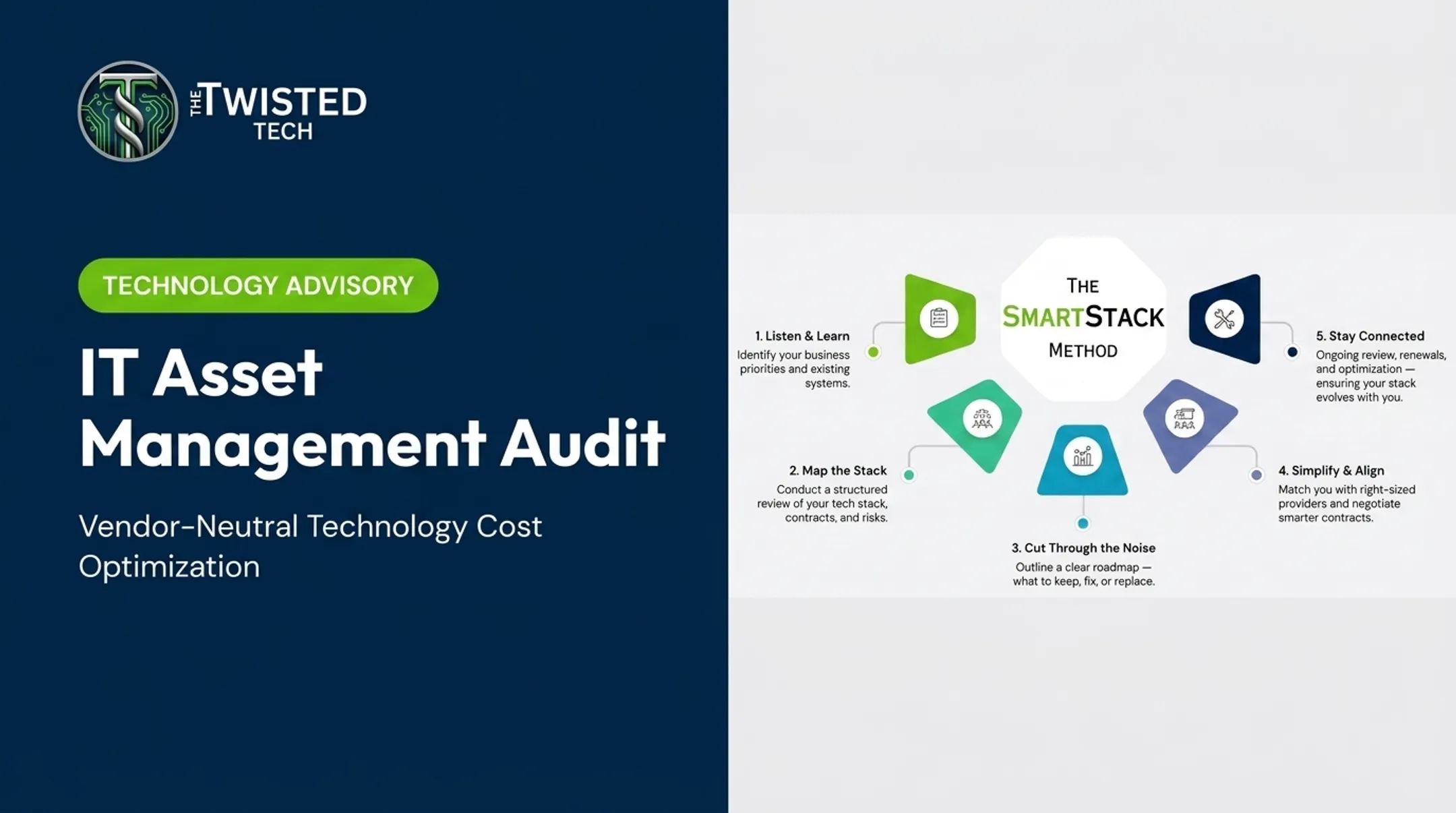
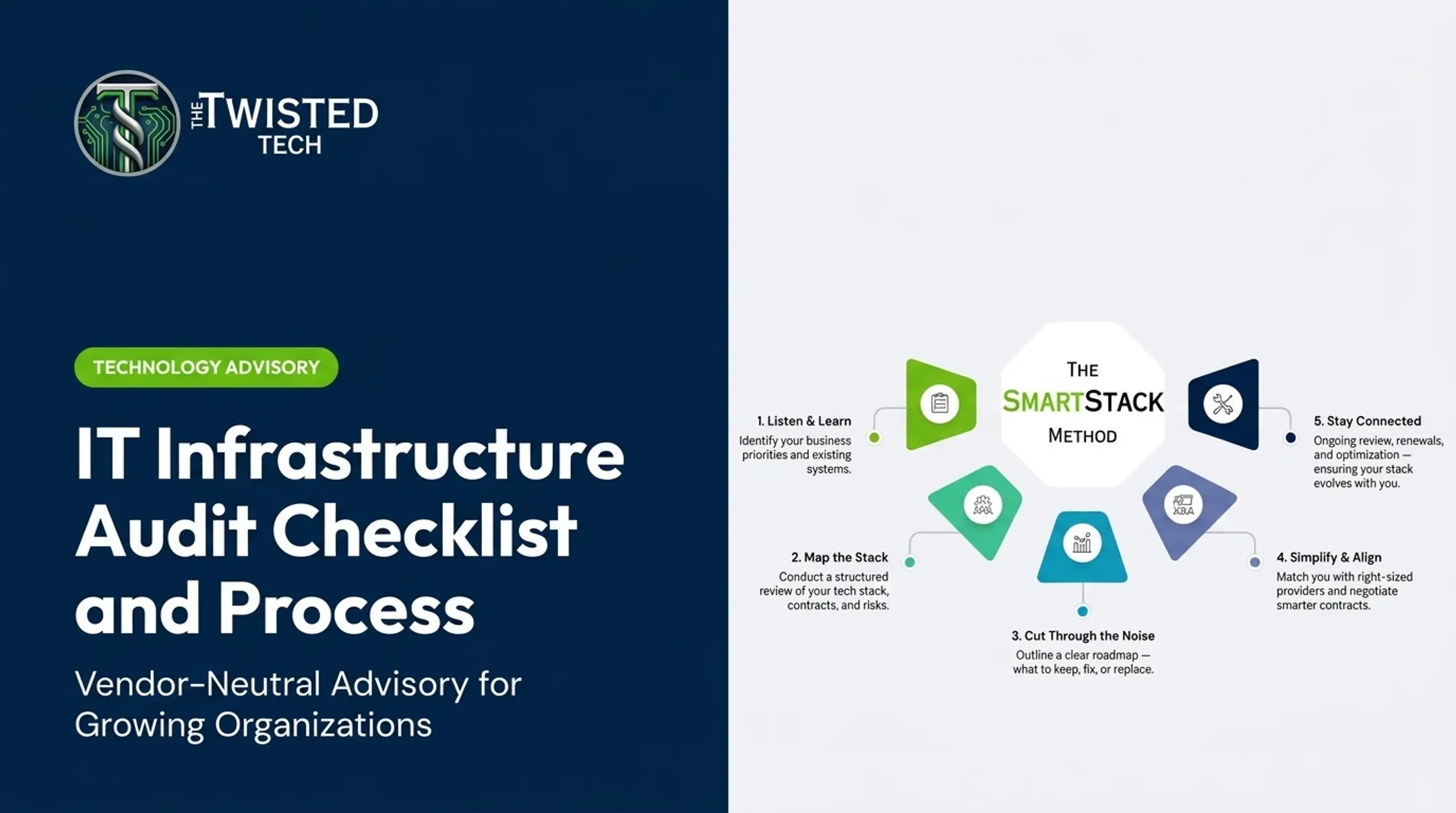
That dual view is also where independent, vendor-neutral guidance helps most: turning findings into decisions instead of another vendor pitch. The Twisted Tech runs advisory work through a five-stage approach:
- Listen & Learn
- Map the Stack
- Cut Through the Noise
- Simplify & Align
- Stay Connected
In one engagement with a private education organization, an audit-driven review of internal IT roles led teams to evaluate managed IT partners before automatically replacing a retiring IT leader with another traditional hire.

That example points to a broader principle: the right recommendation isn't always more technology. Sometimes the fix is better process, clearer ownership, tighter configuration, or consolidating tools you already own. An advisor's job is to test that assumption before recommending a purchase.
Frequently Asked Questions
What does a technology audit do?
It evaluates your technology systems, controls, processes, and risks against your business goals, then identifies gaps and practical improvements. The output should be prioritized, not just a list of technical observations.
What are the four types of audits?
There's no single official four-part standard. The most relevant categories for most organizations are technology/systems audits, cybersecurity audits, compliance audits, and focused audits such as cloud, backup, or third-party risk. Types vary by objective.
How often should a business conduct an IT audit?
Base frequency on risk, business change, compliance obligations, incidents, major implementations, and provider renewals rather than a fixed annual schedule. Most organizations run five or fewer technology audits per year.
What is included in an IT audit?
Typical scope covers assets, infrastructure, applications, access controls, security, data protection, backups, resilience, policies, providers, and applicable compliance requirements. Exact scope depends on your organization and its objectives.
What is the difference between an IT audit and a cybersecurity assessment?
An IT audit can review the broader technology environment and controls, while a cybersecurity assessment usually concentrates on security risks and defensive capabilities specifically. The terms sometimes overlap depending on the provider and stated scope.