
Many organizations end up choosing a platform based on a provider's pitch, a colleague's recommendation, or the panic of an approaching renewal deadline. The result is a patchwork of systems that never quite fit together.
Strategic assessment services are a structured, objective review of your business goals, current technology capabilities, risks, market options, and priorities. The goal is a clear decision framework, not another opinion added to the pile.
This article covers what a strategic assessment examines, which frameworks apply, how the process actually works, and when bringing in independent guidance makes sense.
Key Takeaways
- A strategic assessment connects business goals to technology choices instead of evaluating tools in isolation.
- Strong assessments review the current environment, stakeholder needs, market conditions, risk exposure, and provider options.
- The deliverable should be a prioritized action plan, not just a report full of diagrams.
- Vendor-neutral guidance helps organizations compare options before committing to a contract, platform, or renewal.
Why Growing Organizations Need Strategic Assessment Services
Growth changes what "good enough" technology looks like. Systems that worked for one location, one team, or one budget rarely scale cleanly to five locations, hybrid teams, or an acquisition.
New offices, disconnected systems, legacy platforms, and lean IT staff all add friction. Nobody planned for that stack of friction; it built up one decision at a time.
Common triggers that push organizations toward an assessment include:
- An upcoming contract or platform renewal
- Rising technology costs with no clear explanation
- Service issues with a current provider
- Cybersecurity concerns or new compliance requirements
- Pressure to decide where AI belongs in the business
- A major replacement project (phone systems, network, cloud infrastructure)
- Technology that no longer supports current business objectives
The Cost of Reactive Purchasing
When those triggers hit and technology sits outside the strategic plan, teams often buy under deadline pressure. In an NTEN/Heller Consulting survey of more than 300 nonprofits, 24% said technology wasn't included in their strategic plan at all, and 77% cited insufficient budget as a barrier to technology investment.
That gap shows up beyond nonprofits. A CPA Firm Management Association survey of 140 firms found 71% kept a distinct IT budget, yet 40% operated across multiple offices—where fragmented purchasing multiplies fast.

Reactive purchasing skips the review of dependencies, duplicated tools, and unmet requirements. A structured assessment surfaces those gaps while you still have leverage, not after the contract is signed.
What Does a Strategic Assessment Examine?
A strategic assessment is a business-and-technology review. It asks three questions: where is the organization today, where does it need to go, and what has to change to close that gap.
Starting With Business Context
Before touching a single system, a solid assessment documents:
- Growth plans and operational priorities
- Customer and employee experience expectations
- Budget parameters and risk tolerance
- Decision constraints (timeline, contracts, internal capacity)
This is exactly where The Twisted Tech starts every engagement. Its Technology Strategy & Decision Support approach begins with the business objective or challenge, not a predetermined technology or provider.
Current-State Discovery
Next comes a full inventory of what actually exists:
- Applications, infrastructure, and connectivity
- Communications and collaboration tools
- Cybersecurity posture and cloud services
- Data flow, contracts, providers, and integrations
- Internal ownership of each system
Stakeholder and Market Research
Internal input typically comes from several sources:
- Leadership interviews that reveal strategic priorities
- User feedback that surfaces friction leadership often can't see
- Operational interviews, document review, and usage data
- Provider and contract analysis of spend versus actual use
The assessment also looks outward. Technology trends, provider capabilities, regulatory expectations, and competitive pressure all shape which options are realistic.
Distinguishing an Assessment From Other Engagements
Strategic assessments are easy to confuse with audits, support retainers, and vendor pitches. Purpose and output are where the differences show:
| Engagement Type | Primary Purpose | Typical Output |
|---|---|---|
| Strategic assessment | Inform a decision | Findings, options, prioritized recommendations |
| Technology audit | Test specific controls | Compliance/control findings |
| IT support engagement | Operate day-to-day systems | Ongoing service delivery |
| Vendor consultation | Sell a specific solution | Product-focused proposal |
| Strategic plan | Commit to a roadmap | 12- to 24-month initiative plan |
Gartner's guidance on IT strategic planning describes the strategic plan as a downstream deliverable. It is generally a 12- to 24-month roadmap that builds on assessment findings rather than replacing them.
Strategic Assessment Frameworks and Tools
No single framework fits every organization. Draw from these tools based on the decision in front of you.
SWOT and PESTLE for Context
SWOT organizes internal strengths and weaknesses alongside external opportunities and threats. A technology example: reliable connectivity at your headquarters (strength) against fragmented providers at three regional offices (weakness).
PESTLE looks outward at political, economic, social, technological, legal, and environmental factors. Not every category matters for every decision. A healthcare organization might weigh regulatory factors heavily; a retail company might not need that lens at all.
Gap Analysis and Capability Mapping
These tools compare what you have against what you need. They often surface:
- Missing functionality
- Duplicated tools covering the same problem
- Process friction between systems
- Integration constraints limiting future flexibility
Risk and Maturity Assessments
Risk assessments (following frameworks like NIST SP 800-30) surface and rank risks so you can prioritize cybersecurity, resilience, and governance work. Maturity models establish a baseline and a target state.
One caution: a maturity score is a data point, not a strategy. It tells you where you stand, not what to do about it.

The right framework depends on:
- The specific decision being made
- What evidence is already available
- Organizational maturity
- How urgent the decision is
How Strategic Assessment Services Work
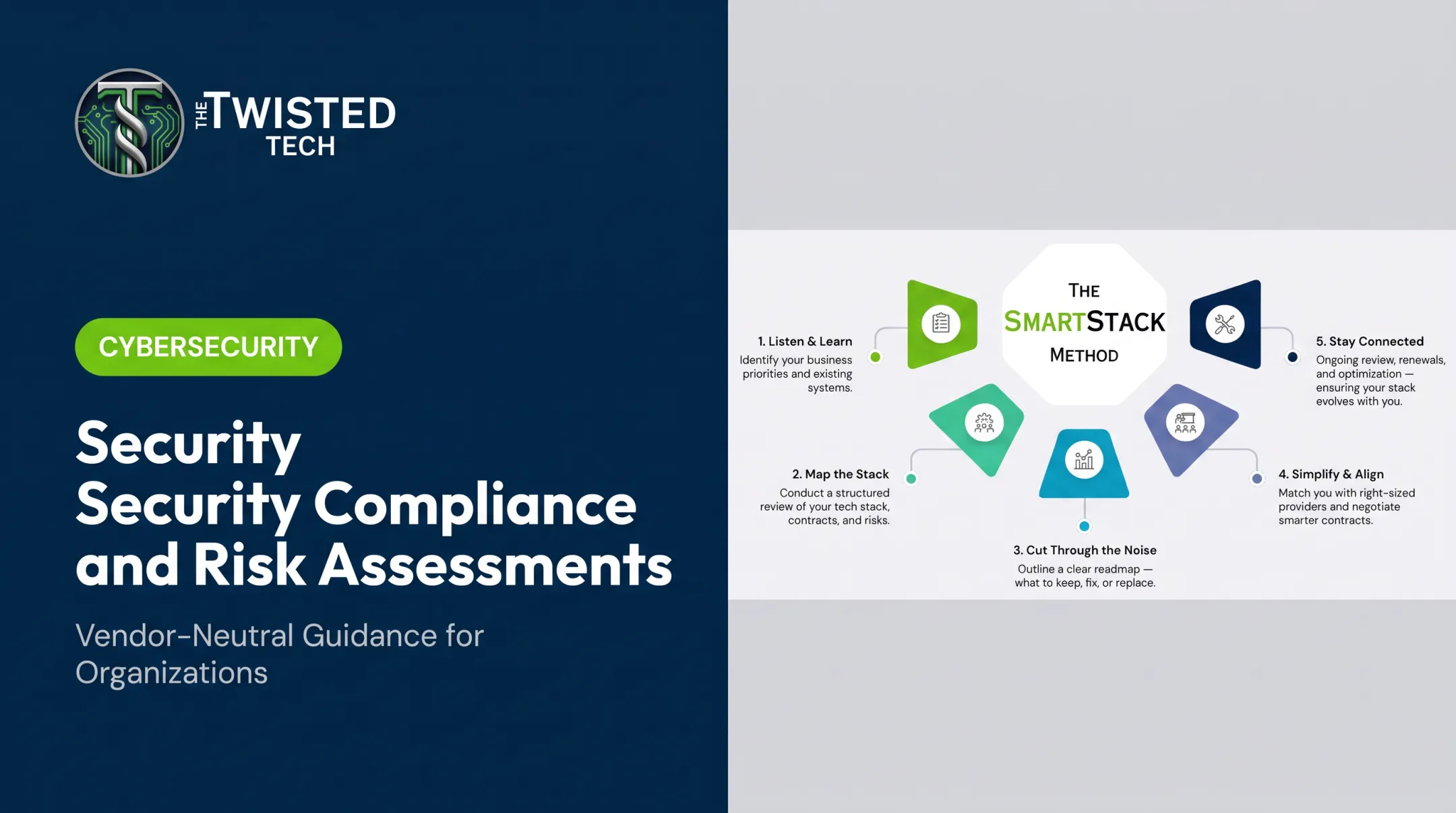
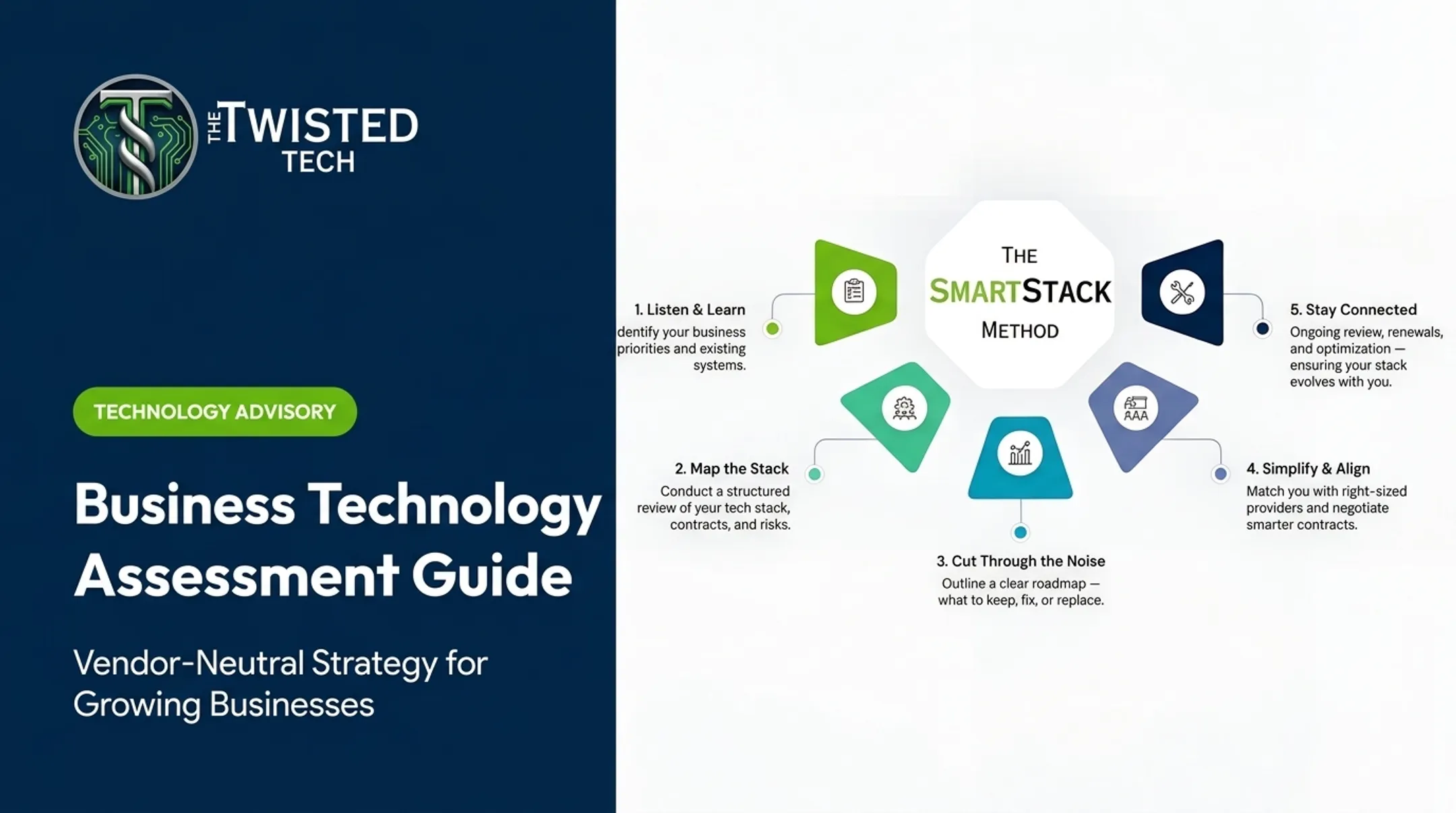
A credible assessment follows a defined sequence. The Twisted Tech structures its work around what it calls the SmartStack approach, but the underlying logic applies broadly.
Scope Definition and Discovery
The process starts by identifying the decision at hand, the business outcomes involved, affected stakeholders, and the systems, locations, and contracts in scope. This is the "Listen & Learn" phase: understanding goals, obstacles, and what success actually looks like.
From there, discovery moves into current-state review, sometimes called "Map the Stack." This stage covers:
- Interviews and workshops with leadership and operational staff
- Technology and contract inventories across every relevant system
- Provider reviews of current relationships and contract terms
- Usage data analysis to compare what's used versus what's paid for
Requirements, Market Research, and Prioritization
Findings become requirements next, with essentials separated from preferences. Technical, financial, security, and support needs are all documented.
Market research and option evaluation follow, comparing multiple providers against transparent criteria rather than brand familiarity or a single vendor's pitch. Recommendations are then prioritized by business value, urgency, risk reduction, and feasibility.
The final output typically includes:
- An executive summary
- Current-state findings
- Documented requirements
- An options comparison
- A risk and gap register
- Prioritized recommendations with decision criteria
- An implementation roadmap
A review session closes the loop so stakeholders can challenge assumptions, clarify trade-offs, and agree on ownership before work moves forward.

Turning Assessment Findings Into an Actionable Technology Roadmap
Findings without structure just become another document nobody revisits. Turning them into a roadmap means giving each recommendation an owner, a timeline, and a defined outcome.
Organizing by Timeframe
Break initiatives into three buckets:
- Immediate actions — quick fixes with low risk and high impact
- Near-term improvements — changes requiring some planning or budget approval
- Longer-term modernization — larger projects tied to growth or major replacements
This staged approach lets an organization make progress without trying to overhaul everything simultaneously.
Readiness Matters as Much as the Plan
A roadmap only works if the organization can actually execute it. Readiness factors include:
- Internal capacity and change management
- Training and user adoption
- Data migration and integration work
- Procurement and security review
- Provider coordination and post-launch support
A Practical Example
Consider an organization managing fragmented communications and network services across several locations. Discovery reveals overlapping contracts and inconsistent connectivity.
Leaders define requirements by location and use case, then compare providers through market research. The roadmap sequences work so the easiest consolidations happen first, with higher-complexity sites modernized in later phases.
An independent advisor can support each stage. That includes comparing providers, evaluating proposals, negotiating terms, and coordinating implementation—always tied back to the original business objective.
An assessment isn't a one-time document. Business needs, provider capabilities, contracts, and risks all shift, so revisit it when any of those change materially.
When to Engage a Strategic Assessment Advisor
Some situations call for outside perspective. Common signals include:
- Limited internal IT capacity relative to the decision's complexity
- Multiple providers with unclear overlap
- An upcoming renewal with no clear negotiating position
- A major replacement project (communications, network, cloud)
- Conflicting stakeholder requirements
- Poor vendor performance with no obvious alternative
- Rapid growth outpacing current infrastructure
- Uncertainty about AI, cybersecurity, or cloud strategy
What to Look for in an Advisor
Not every advisor is actually independent. Before engaging one, evaluate:
- Independence: do they resell the options they recommend?
- Technology breadth: can they cover your full environment, not just one category?
- Discovery methodology: is it structured, or just a sales conversation?
- Transparency: are evaluation criteria documented and shared?
- Implementation support: do they help after the report, or disappear?
Ask directly: how are conflicts of interest handled? Who owns the final recommendations? What happens after the assessment is delivered?
An Independent Perspective on the Market
The Twisted Tech is an independent, vendor-neutral advisor for growing, customer-focused organizations facing these decisions. The team starts with the business objective, then brings market research, provider comparisons, and implementation coordination into the process.
If you're facing a major technology decision, an approaching renewal, or a replacement project and want an outside perspective before committing, reach out to The Twisted Tech for an initial conversation. You don't need a finished strategy or a vendor list to start.
Frequently Asked Questions
What are the 5 P's of strategy?
Henry Mintzberg's framework describes strategy as Plan, Ploy, Pattern, Position, and Perspective. It helps examine both deliberate strategy and the patterns that emerge from repeated decisions over time.
What are the three main types of assessment strategies?
Assessments commonly examine internal capabilities, the external market environment, and strategic fit or readiness. In technology terms, that means current systems, provider options, and how well a solution matches organizational goals.
Can you give me an example of a strategic analysis?
An organization might assess its current communications setup, research market alternatives, flag contract risks, and document requirements before choosing a new provider. The analysis then compares fit, cost, and implementation complexity across options.
What are the 5 components of a strategic plan?
Common components include mission, vision, goals or objectives, strategies or initiatives, and measures or action plans. Terminology differs across frameworks, but the structure still connects purpose to measurable action.