
Introduction
The right system is the one that fits your organization's objectives, workflows, users, risk tolerance, and growth plans. A long feature list alone rarely delivers that fit.
Too many technology decisions get derailed by disconnected systems, vague requirements, and provider bias baked into the sales process. Add rising costs, weak integrations, and IT teams stretched thin, and it's no surprise that 77% of US technology decision-makers report moderate to extensive tech sprawl, according to Forrester's Q2 2024 Tech Pulse Survey.
This guide breaks selection into six practical criteria:
- Business fit
- Technical and operational fit
- Financial value
- Vendor capability
- Implementation readiness
- Long-term flexibility
Get these right, and you'll avoid buying a system that looks impressive in a demo but creates problems six months in.
Key Takeaways
- Tie every selection criterion to a business outcome, then sort requirements as critical, mandatory, desirable, or out of scope
- Evaluate the full solution, not just the demo, including integrations, security, support, and exit terms
- Compare total cost of ownership and long-term value, not just the initial quote
- Use a structured, vendor-neutral process to protect negotiation leverage
- Document decisions so stakeholders stay aligned and accountable
Start With Business Objectives and Requirements
Selection shouldn't start with a product name or a favorite vendor. It should start with the problem you're solving.
Common drivers include:
- Improving customer experience
- Simplifying a fragmented tech environment
- Supporting growth or cutting manual work
- Strengthening cybersecurity
- Preparing for a contract renewal
Whatever the driver, define it clearly before you look at a single feature list.
Map the Current State First
Before defining what you need, document what you have:
- Key workflows and how work actually moves through them
- Systems, providers, and data flows currently in use
- Pain points, manual workarounds, and ownership gaps
- Dependencies that could complicate a change
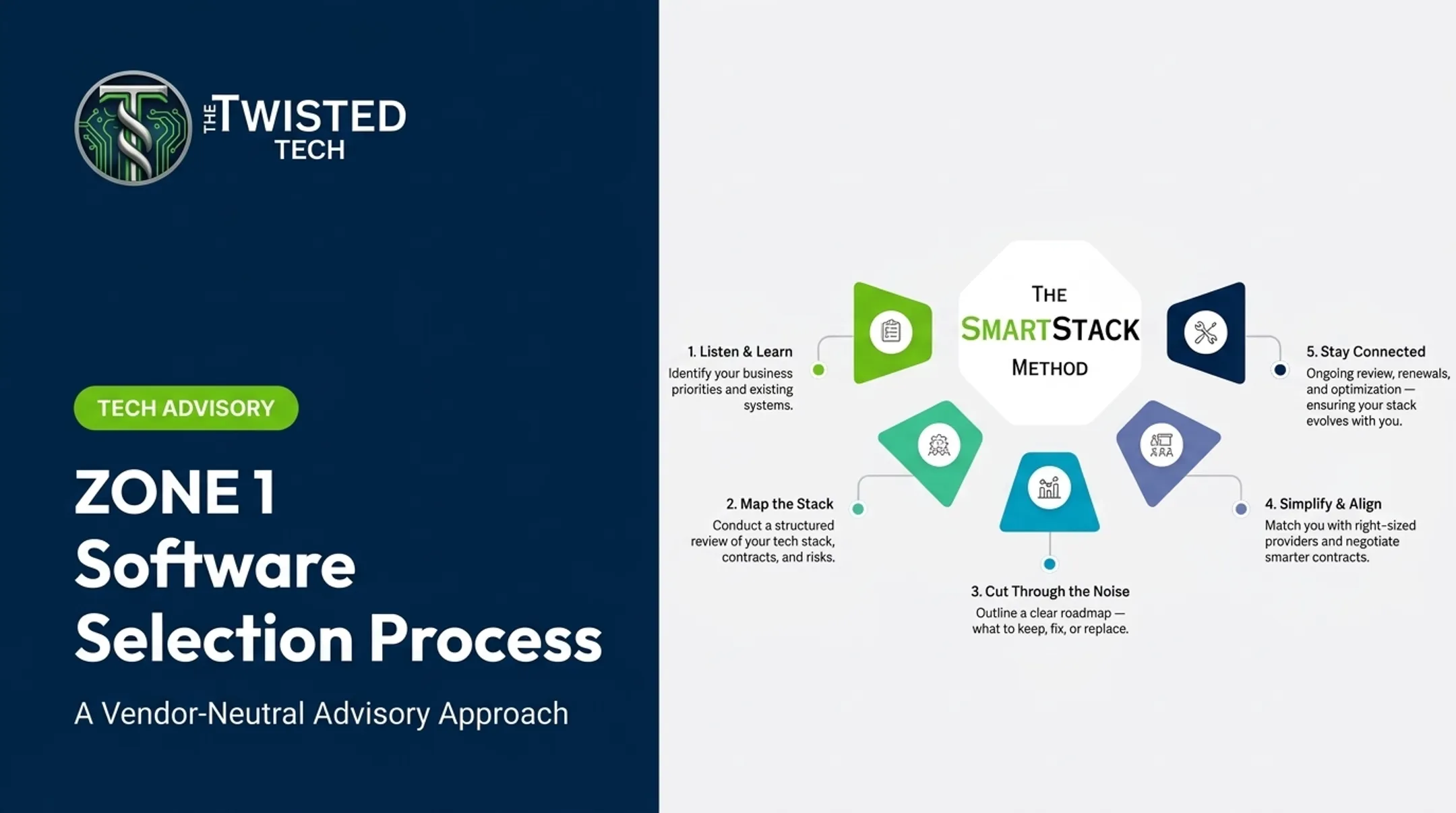
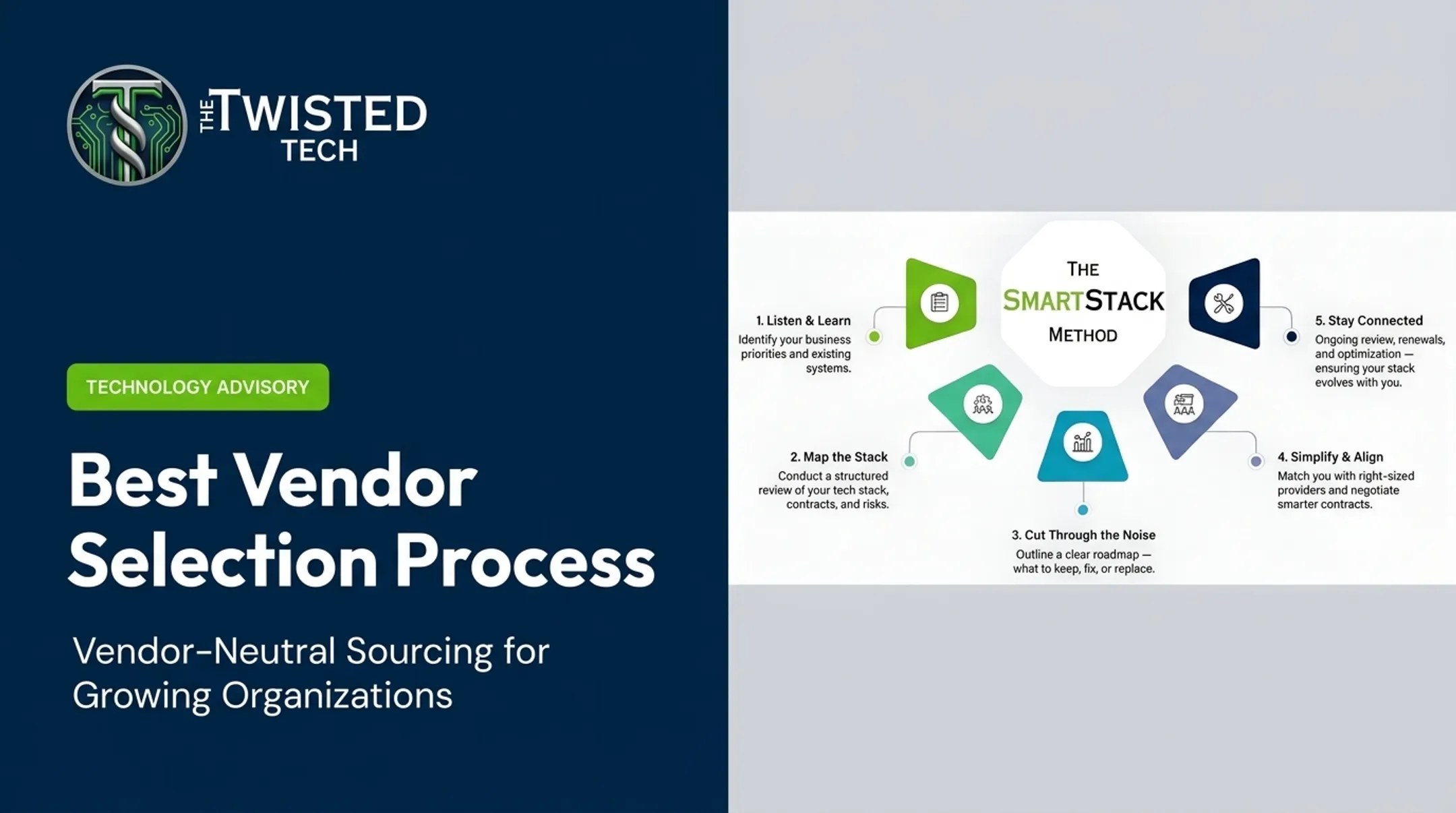
This is exactly where The Twisted Tech's discovery process starts. The "Map the Stack" phase of its SmartStack approach reviews existing technology, providers, contracts, workflows, and integrations to surface what's working and where the friction actually lives.
Build Requirements From Future-State Outcomes
Skip the generic checklist. Build requirements from the outcomes you're trying to achieve, covering:
- Functional needs — what the system must do
- User needs — who touches it and how
- Process and reporting needs — how it fits daily operations
- Service and continuity needs — support and uptime expectations
Then prioritize. Sort every requirement into one of four buckets:
- Critical
- Mandatory
- Desirable
- Out of scope
Assign an owner to each one, document why it matters, and define how you'll verify a provider can meet it.
Pull in stakeholders early — executives, IT, security, finance, operations, and end users. Misalignment here gets expensive later.
Without documented decision ownership, teams often cannot say who made the final vendor call when a selection goes wrong.
Define success indicators upfront. According to PMI's 2024 Project Success Report, projects with defined success criteria scored a Net Project Success Score of 41, compared to just 20 for those without. Projects with an established measurement system scored 43 versus 6. These are associations, not guarantees, but they make a clear case for documenting what success looks like before you buy.

Evaluate Technical and Operational Fit
Once requirements are set, test whether a system actually works inside your environment—not just on a vendor's slide deck.
Integration and Security Come First
Start with how the new system connects to what stays. Look at existing applications, identity systems, communication tools, data sources, APIs, and reporting. Ask vendors for specifics, not assurances — practical connection effort matters more than a checkbox on a features page.
Security and compliance need the same scrutiny. Assess:
- Data ownership and access controls
- Backup, disaster recovery, and resilience
- Auditability and independently verifiable documentation (not just vendor claims)
ISO/IEC 25010 offers a recognized model for evaluating product quality across nine characteristics, while a SOC 2 report — as described by the AICPA — verifies a vendor's internal controls. These measure different things. Don't let one substitute for the other.
Scalability, Deployment, and Usability
Look three years out, not only at today. Check whether the system can keep up:
- Added users, locations, or workflows
- Growth without forcing another rip-and-replace
- Deployment fit: cloud, hosted, on-premises, or hybrid matched to your expertise, risk tolerance, and connectivity
On-premises and private cloud aren't interchangeable; NIST's cloud computing definitions make that distinction clear. How you deploy also shapes who can run and support the system day to day.
Usability decides whether people actually use it. Evaluate:
- End-user experience and accessibility
- Administrator burden and configuration complexity
- Training requirements and mobile/remote access
Test with realistic workflows, not vendor scripts.
In one AI chatbot evaluation The Twisted Tech supported, a finalist built a tailored demo environment so the client's team could walk their own customer journey before deciding. That kind of test surfaces configuration effort, integration gaps, and hidden fees a polished generic demo can hide.
Assess Cost, Risk, and Long-Term Value
The sticker price is rarely the real price. Total cost of ownership includes far more than a subscription fee.
What Total Cost of Ownership Actually Includes
Beyond the quote, factor in:
- Implementation, configuration, and data migration
- Integration work and training
- Ongoing support and licensing changes
- Hardware or connectivity dependencies
- Internal labor hours
- Renewal increases and legacy system decommissioning
Gartner's TCO research warns that a narrow focus on unit price can obscure the true lifecycle cost of a system. That gap is where budgets quietly blow up.
Weigh Value Against Risk
Weigh benefits against the risks that come with them:
- Implementation complexity and operational disruption
- Security exposure during transition
- Dependency on specialized internal resources
- Contract constraints and the cost of switching later
Contract terms deserve their own line of scrutiny:
- Pricing transparency and minimum commitments
- Renewal terms and service levels
- Escalation paths and data portability
- Termination rights and exit costs
Who owns your configurations and data if you leave? What does it cost to make changes down the road?
Those answers belong in the same model as your costs and benefits. Build one document that separates:
- One-time costs
- Recurring costs
- Optional costs
- Assumptions behind each number
- Expected benefits
Test this model against more than one growth scenario. A quote based on today's usage rarely holds up in year three.
Evaluate Vendors and the Selection Process
Once requirements and cost models are solid, it's time to test the market, not just one provider's pitch.
Build a Structured Evaluation Sequence
A repeatable process protects you from decision fatigue and vendor bias alike:
- Finalize your requirements document so every vendor is scored against the same criteria
- Issue an RFI or RFP to gather structured, comparable responses
- Shortlist vendors based on documented fit, not demo polish
- Run structured demonstrations using your real workflows
- Collect written responses and check references independently
- Compare solutions and commercial terms side by side
- Negotiate and finalize approval with stakeholders aligned

Score consistently using a weighted model that separates must-haves from nice-to-haves. Record evidence, assumptions, unresolved risks, and stakeholder confidence for each vendor, not just a gut feeling after the demo.
Evaluate the Relationship, Not Just the Product
Technology outlives the sales cycle. Look at account management, implementation resources, support responsiveness, escalation paths, and roadmap transparency. Ask for references and gauge whether the provider's pace actually matches yours.
Keep more than one viable option through negotiation. This isn't about running a fake bidding war. It's about maintaining real leverage and exposing assumptions you'd otherwise miss.
This is where The Twisted Tech operates as an independent, vendor-neutral advisor. With access to more than 200 technology providers, the company coordinates requirements development, market research, proposal comparison, negotiation, and implementation planning.
That support fits growing organizations with lean IT teams and complex technology environments. Compensation typically comes through established provider channel programs rather than client fees, so there's generally no added consulting cost.
Avoid Common System Selection Mistakes
Even organizations with good intentions fall into predictable traps.
Common selection mistakes include:
- Choosing based on a polished demo, brand familiarity, or one stakeholder's preference
- Picking the lowest initial price without comparing total value
- Writing vague requirements that invite scope creep
- Over-customizing a system instead of adjusting the process
- Ignoring integration effort until after signing
- Excluding end users from evaluation
- Treating security and support as an afterthought
Those mistakes often show up later as adoption failure. Prosci's change management research found that 88% of projects with effective change management met or exceeded their objectives, compared to just 13% with poor change management.

That gap is why implementation planning belongs in selection, not after the contract is signed. Prosci's research on change management principles treats rollout capability as part of system fit.
That same pattern showed up in the AI chatbot evaluation described earlier, where competing claims were turned into an apples-to-apples comparison before anyone picked a finalist.
A finalist then built a live demonstration environment before the client committed. That step surfaced gaps a standard sales demo never would have shown.
Run a Final Readiness Check
Before signing, confirm:
- Requirements are documented and prioritized
- Scoring evidence and assumptions are recorded
- Implementation responsibilities are assigned
- Data migration and adoption plans exist
- Support and renewal terms are clear
Decision ownership should be explicit, not assumed. If you are approaching a major technology decision, an independent review before signing can catch gaps a vendor-led process will miss. The Twisted Tech provides that vendor-neutral perspective when organizations want a second set of eyes on fit, risk, and readiness.
Frequently Asked Questions
Why is process selection important in system design?
Selecting the right process before configuring or purchasing a system aligns workflows, data, roles, and controls with your business objectives. Clear process definition reduces unnecessary customization and implementation risk.
What are the most important system selection criteria?
Key criteria include business requirements, functional fit, integration, security, usability, scalability, total cost of ownership, provider capability, implementation support, and contract terms. Evaluate them together, not in isolation.
How do you prioritize system requirements?
Classify each requirement as critical, mandatory, desirable, or out of scope. Validate these priorities with stakeholders and connect each one to a specific business outcome.
How should you compare technology vendors?
Use consistent requirements, structured demonstrations, weighted scoring, written responses, and reference checks. Evaluate implementation capability, service quality, and commercial terms, and require evidence behind any vendor claim.
What is the difference between system selection and implementation?
Selection determines which system and provider best fit your organization. Implementation covers configuration, integration, migration, testing, deployment, and adoption. Strong selection planning sets implementation up to succeed.
How can you evaluate the total cost of a system?
Look beyond the vendor quote to implementation, integrations, migration, training, support, internal labor, upgrades, renewals, infrastructure, and exit costs. Model total cost across multiple usage scenarios, not just current-state assumptions.