
Introduction
Ask five providers to explain the difference between a "cloud-based phone system" and "VoIP," and you'll likely get five different answers. Many use the terms interchangeably in their marketing, which makes comparing quotes and features genuinely confusing.
This matters more than semantics. The FCC counted more than 43.9 million interconnected VoIP subscriptions among US businesses as of mid-2025, alongside roughly 8.6 million switched-access lines still in use, according to FCC voice telephone service data.
Organizations replacing legacy phone lines need to know exactly what they're buying, not just what the brochure calls it.
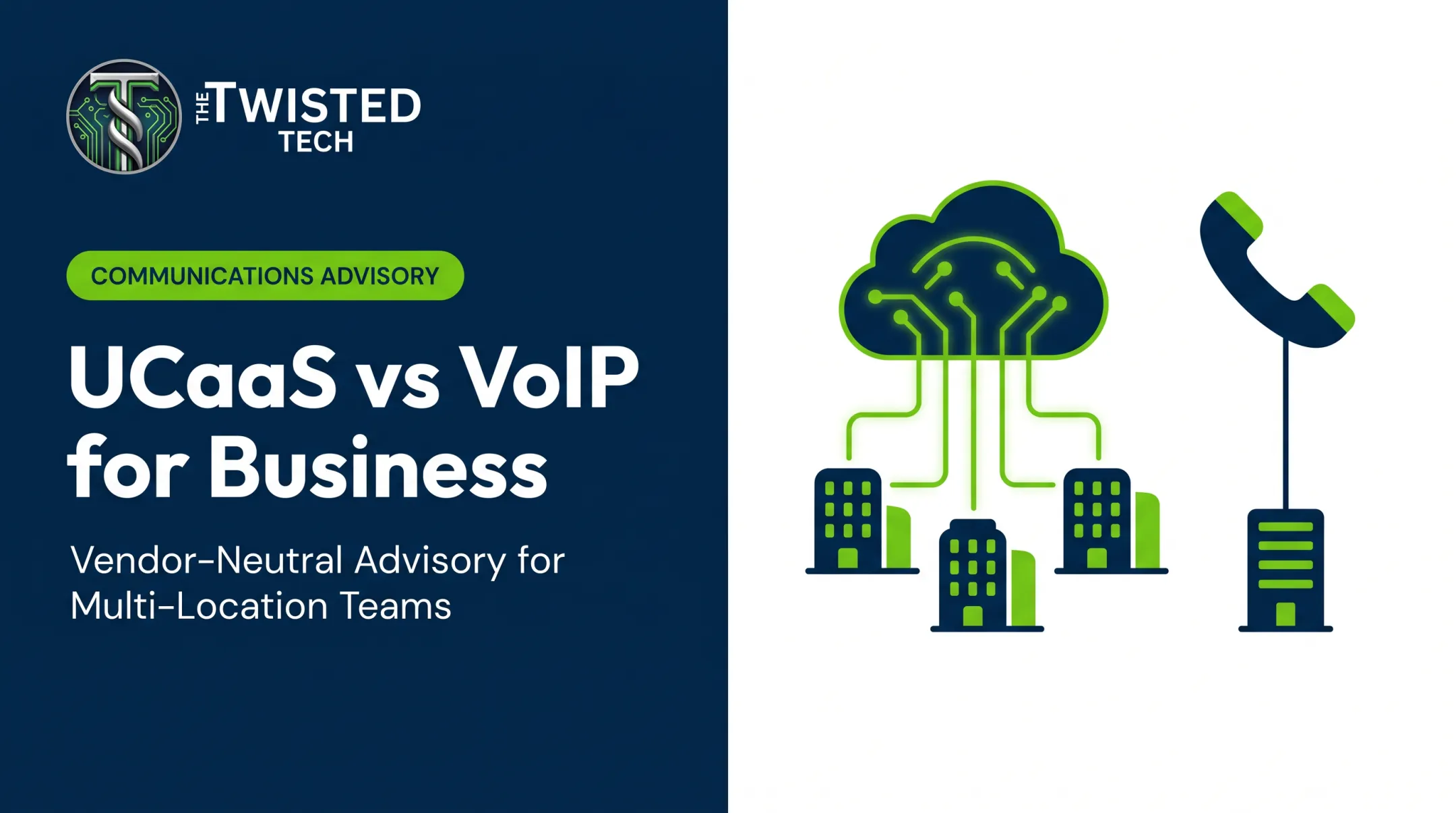
Here's the short version: VoIP is the underlying technology that carries voice as digital data over an IP network. A cloud-based phone system is typically a provider-hosted service built on that technology.
Which one fits your organization depends on infrastructure, IT resources, and risk tolerance, not on which label sounds more modern. This guide breaks down architecture, ownership, and cost so you can evaluate options with clearer criteria.
Key Takeaways
- VoIP describes how voice traffic travels; a cloud-based phone system describes how the service is hosted and managed
- Most modern cloud phone systems run on VoIP, but the terms aren't interchangeable
- Compare ownership, network dependency, scalability, security, and total cost, not just price per user
- Evaluate the full service model and provider responsibilities before signing a contract
Cloud-Based Phone Systems vs. VoIP: Quick Comparison
Here's how the two concepts stack up across the factors that drive a purchasing decision.
Definition and Core Distinction
A cloud-based phone system is a provider-hosted business phone service. The provider operates the core infrastructure, including servers, PBX software, and call routing, and delivers features to your team through internet-connected devices.
VoIP is the technology that converts voice into digital packets and sends them over an IP network. It's a transport method, not a finished product. VoIP can run inside a cloud phone system, an on-premises IP PBX, a SIP trunk connected to existing equipment, or a hybrid setup.
Hosting, Cost, and Scalability at a Glance
| Factor | Cloud-Based Phone System | VoIP Technology |
|---|---|---|
| Management | Provider manages servers, updates, and core infrastructure | Business may manage phones, network, IP PBX, or session border controllers |
| Cost structure | Recurring per-user subscription, plus possible implementation and hardware fees | Varies by deployment: hosted, on-premises PBX, SIP trunking, or hybrid |
| Scalability | Easier provisioning across users and locations, mobile apps included | Enables internet-based calling but doesn't guarantee easy scaling on its own |
| Reliability factors | Provider uptime, data-center redundancy, SLA terms | Network design, bandwidth, latency, jitter, packet loss |
A cloud-based phone system is one common way to deliver VoIP, but it isn't the only way. "VoIP" alone tells you nothing about who's responsible for uptime, security, or support. The sections below break down how that split shows up in features, deployment, and day-to-day ownership.
Cloud-Based Phone Systems and VoIP: What Each Term Means
What Is a Cloud-Based Phone System?
A cloud-based phone system is a hosted communications service. The provider runs the core phone platform in remote data centers, so your organization isn't maintaining a complete phone system on site.
Cloud-hosted communications have become the default for many organizations. One 2024 industry study found that 50.4% of surveyed businesses used only a cloud-based (UCaaS) platform, with no on-premises system involved, according to Metrigy's UCaaS market research.
Standard capabilities typically include:
- Business phone numbers and extensions
- Auto attendants and call queues
- Voicemail, call forwarding, and call recording
- SMS, video calling, and basic analytics
- CRM integrations and desktop or mobile apps
Advanced analytics, contact center features, and premium integrations are often add-ons rather than standard inclusions, so read the feature comparison closely.
For growing and multi-location organizations, this model means faster user changes, less on-site hardware, and more predictable monthly budgeting. It also supports hybrid work without requiring a physical phone at every desk.
Trade-offs still apply. A cloud phone system depends on internet and power availability at each location, and the provider controls upgrade timing and data handling. Some platforms add usage fees or feature tiers that inflate the advertised price. Switching later can mean retraining staff and reconfiguring call flows, so review exit terms before you sign.
Use Cases of Cloud-Based Phone Systems
- Growth without new infrastructure — add users, locations, and call flows without building a separate phone system at every site
- Remote and hybrid teams — staff use softphones, browsers, mobile apps, or compatible desk phones while keeping consistent caller ID and routing
- Customer-facing teams — queues, recording, analytics, CRM integration, and a path toward contact center functionality
- Legacy voice replacement — organizations retiring POTS, copper, or aging PBX equipment
That last use case deserves attention. Six systems commonly still ride on old copper lines: fire alarm panels, elevator emergency phones, security alarms, fax machines, emergency call boxes, and standard analog business lines.
Carriers are retiring copper facilities nationwide, and FCC rules require notice periods of up to 180 days for business customers before service changes take effect, per FCC guidance on network modernization. Missing even one connected device during a migration can create a compliance or safety gap.
What Is VoIP?
Voice over Internet Protocol is the transmission of voice communications over an IP network instead of a traditional circuit-switched telephone line, per the FCC's consumer guidance on VoIP and 911 service. In practical terms, your voice gets broken into digital packets, sent across the internet, and reassembled on the other end.
VoIP itself is a technology, not a complete phone system, provider, or feature set. It shows up in several deployment models:
- Hosted VoIP / cloud phone service — the provider manages the platform
- On-premises IP PBX — the business owns and maintains the equipment
- SIP trunking — connects an existing PBX to a provider's IP network
- Hybrid architecture — a mix of on-site and hosted components
VoIP generally supports flexible endpoints, internet-based call routing, and integration with business software. It doesn't automatically guarantee lower costs or better call quality. Those outcomes depend on network readiness and the deployment you choose.
Use Cases of VoIP
- On-premises or hybrid control — organizations with specialized requirements, existing PBX investments, or in-house IT expertise
- SIP trunking as a bridge — connects an existing PBX to a provider's network, avoiding an immediate rip-and-replace project
- Multiple endpoint types — desk phones, softphones, mobile devices, conference rooms, and contact center endpoints (validate compatibility before purchase)
Two businesses running "VoIP" can have completely different experiences. One might run a fully managed hosted platform with 24/7 support. Another might run an aging on-premises IP PBX over a congested internet connection. Same underlying technology, very different day-to-day reality. Compare hosting models and service commitments, not labels alone.

Cloud-Based Phone Systems vs. VoIP: Which Is Better for Your Business?
Asking which one is "better" sets up a false choice. VoIP is a technology; a cloud-based phone system is a delivery model built on it. The real question is which architecture and provider match your organization's requirements, constraints, and risk tolerance.
Choose a Cloud-Based Phone System When...
A hosted platform tends to fit organizations that:
- Have lean IT resources and want the provider to manage core infrastructure
- Support remote or multi-location employees
- Need faster access to new features and integrations
- Want predictable, subscription-based budgeting
Before selecting a provider, validate:
- Network readiness and quality of service (QoS)
- Redundancy, failover, and emergency-calling (E911) compliance
- Number porting timelines
- Mobile and desktop app functionality
- Data protection and admin controls
- Support coverage and contract flexibility
This is where independent, vendor-neutral guidance earns its keep. The Twisted Tech works with organizations to define these requirements, compare providers side by side, and negotiate contract terms before anything gets signed, as advisory support rather than a product pitch.
Choose a Self-Managed or Hybrid VoIP Model When...
More direct control over infrastructure may make sense if your organization has:
- Specialized systems or existing hardware worth preserving
- Internal technical expertise to manage a PBX
- Specific data-handling or operational requirements
- A phased migration strategy rather than an immediate switch
That control comes with added responsibility:
- Purchasing and maintaining hardware
- Managing upgrades and backups
- Securing the network
- Monitoring call quality
- Planning redundancy
- Sourcing specialized expertise when issues arise
A hybrid approach can bridge the gap. Organizations can preserve certain equipment or locations while gradually moving other users to a hosted platform, often a more realistic path than an all-at-once cutover.
What Total Cost of Ownership Actually Includes
Subscription price is just one line item. A complete comparison should account for:
- Internet upgrades and network equipment
- Handsets, licenses, and add-on features
- Taxes, regulatory fees, and installation charges
- Number porting and staff training
- Ongoing support, maintenance, and contract commitments
- Exit or migration costs if you switch providers later
Cost alone does not determine success. A reliable deployment also needs a readiness assessment covering:
- Bandwidth, latency, jitter, and packet loss
- Wi-Fi coverage, switch, and firewall configuration
- Power continuity and emergency-calling (E911) requirements
Most implementation problems start when teams skip this step. Common gaps include incomplete analog-line inventories, unclear ownership between provider and customer, and insufficient call-flow testing before go-live.
The fix is straightforward. Build a written requirements document, separate essential capabilities from nice-to-haves, and test every finalist vendor against your actual user workflows before signing a multi-year contract.

Real-World Decision Scenarios
Use these situations to match your constraints to the right approach—not the marketing label.
Scenario 1: The lean-IT, hybrid-workforce organization. A growing company with a small IT team and mixed in-office/remote staff needs fast provisioning, mobile access, and predictable support. After you confirm network readiness and security requirements, a provider-hosted cloud phone system is usually the practical fit. It moves infrastructure management to the provider.
Scenario 2: The multi-location organization with legacy equipment. A company running an existing PBX, specialty analog devices, or a complex call environment wants to modernize without disrupting daily operations. SIP trunking or a phased hybrid migration retires aging components gradually instead of forcing a rip-and-replace.
Scenario 3: The customer-facing organization. A business that needs advanced routing, analytics, CRM integration, or contact center capabilities should judge the full platform and provider expertise. The marketing label—"VoIP" or "cloud"—matters far less than fit.
One engagement shows why the full picture matters more than the label. A multi-location organization with more than 250 remote sales employees set out to evaluate alternatives to its existing communications platform.
During that review, The Twisted Tech identified roughly $8,000 per month in unnecessary Microsoft licensing costs the organization hadn't been tracking. That only surfaced because the evaluation covered the whole technology stack, not just the phone system.
Not every evaluation ends in a switch. In a separate case, a growing financial services organization seriously considered replacement over reporting and operational concerns. After a full evaluation, it kept its incumbent platform. Sometimes the best outcome is confirming what you already have still works.

Before you request proposals, document:
- Users, locations, and call flows
- Devices and required integrations
- Regulatory needs and service expectations
- Contract and renewal deadlines
That prep makes vendor comparisons faster and harder to game with incomplete quotes.
Conclusion
VoIP and cloud-based phone systems aren't competing choices; they're usually complementary. VoIP identifies the underlying communications technology. A cloud-based phone system identifies a common way that technology gets hosted and delivered.
The decision that matters is which architecture and provider match your documented requirements, not which term appears in a sales deck. That choice affects service continuity, user mobility, scalability, customer experience, IT workload, security, and total cost of ownership for years. Choose based on what your organization needs to run reliably, not on terminology alone.
Frequently Asked Questions
Is a cloud-based phone system VoIP?
Most cloud-based phone systems use VoIP to carry calls, but VoIP is only the transport method. That same technology can also run in on-premises or hybrid setups, not just on hosted platforms.
Is WhatsApp VoIP?
WhatsApp's voice and video calling runs over an internet connection, which fits the broad definition of VoIP. It's not, however, a complete business phone-system replacement with features like auto attendants or call queues.
Is a PBX system better than VoIP?
They're not opposing options. An on-premises IP PBX can use VoIP, and a hosted cloud system can deliver PBX-style features without customer-owned equipment.
Is a cloud phone system the same as VoIP?
Not exactly. VoIP is the transport technology; a cloud phone system is the hosted delivery model built on it. Many providers use the terms interchangeably in marketing, which blurs the distinction.
What should a business check before switching to a cloud phone system?
Before you sign, confirm network readiness, required features and integrations, number porting, E911 compliance, security, provider support, contract terms, device compatibility, and a clear migration plan.