
Introduction
Choosing a managed service provider affects cybersecurity, uptime, employee productivity, technology spending, and your organization's readiness for compliance audits or growth. It is a business decision with operational consequences, not a pure IT purchase.
Many organizations struggle with MSP selection because they start backward. They sit through sales presentations, compare monthly fees, and pick whichever provider seems most polished. That approach skips the one thing that should drive the decision: your actual business requirements.
The average cost of a U.S. data breach reached $11.50 million in 2026, up from $10.22 million the year before, according to IBM's Cost of a Data Breach Report. That's a risk benchmark, not a promise of what any MSP will save you. But it shows why the stakes of this decision are real.
This guide walks through the full process:
- Defining needs and choosing a support model
- Building a shortlist and evaluating evidence
- Comparing proposals and reviewing contracts
- Planning ongoing governance after you sign
Key Takeaways
- Document responsibilities, risks, and technology gaps before contacting any provider
- Evaluate scope, security, experience, scalability, and pricing together, not in isolation
- Compare providers on itemized total cost, not monthly price alone
- Validate every claim through references, sample SLAs, and documented security practices
- Treat MSP selection as an ongoing relationship, not a one-time purchase
What Is a Managed Service Provider (MSP)?
An MSP is an external technology partner that takes ongoing responsibility for agreed areas of your IT environment. That can include help desk support, infrastructure monitoring, cloud management, cybersecurity coordination, backup and recovery, or long-term technology planning.
There are two primary operating models:
- Fully managed: The MSP owns most day-to-day IT responsibilities, often for organizations without a dedicated internal IT team.
- Co-managed: The MSP supplements an existing internal team with extra capacity, specialist expertise, tools, or after-hours coverage.
The right fit depends on internal capabilities, risk tolerance, locations, operating hours, and technology complexity—not headcount alone. A 40-person healthcare clinic with strict compliance needs may require more structured support than a 200-person company with a mature IT team.
Core Responsibilities to Clarify Before Evaluating Providers
Before you talk to a single provider, document who currently owns each of these areas:
- User support and endpoint management
- Networks and connectivity
- Cloud platforms and identity management
- Cybersecurity monitoring and incident response
- Backup and disaster recovery
- Vendor coordination and licensing
- Projects and long-term technology strategy
When ownership is unclear, problems that cross multiple systems or providers tend to sit in limbo while everyone points elsewhere. A network outage that touches your ISP, your firewall vendor, and your cloud platform can take hours longer to resolve if nobody has clear authority to drive the fix.
Select only the services tied to a defined business need. A broad package with capabilities you'll never use adds cost without adding value.
Benefits of Using an MSP
The right MSP relationship can deliver:
- Access to specialized expertise you'd struggle to hire in-house
- More consistent support across locations and hours
- Better visibility into your environment through reporting and monitoring
- Stronger risk management through structured processes
- Simplified vendor coordination when issues span multiple systems
- More capacity for your internal team to focus on strategic work
None of this is automatic. Value depends on scope, service quality, how much internal workload decreases, and whether outcomes are measurable. A fixed monthly fee often beats repeated unplanned repairs—but only when the scope matches real needs and results are tracked.
What to Consider When Choosing an MSP
Weigh each factor against your organization's priorities, operational risks, and desired outcomes, not against a generic checklist.
Before requesting proposals, write a requirements brief covering:
- Organization size, user count, and locations
- Critical applications and current providers
- Recurring problems and compliance obligations
- Support hours, growth plans, and desired improvements
This brief becomes your evaluation baseline. Every provider gets measured against the same document.
Define the Operating Model and Selection Criteria
Decide whether you need fully managed, co-managed, project-based, or specialized support. Then identify which responsibilities must stay internal regardless of who you hire.
Convert your business goals into concrete evaluation criteria, such as:
- Reducing recurring downtime
- Improving response consistency across incidents
- Simplifying the number of vendors you manage
- Strengthening security posture
- Supporting an upcoming expansion or new location
Separate mandatory requirements from preferred capabilities. This lets you screen providers consistently instead of getting swayed by an impressive feature that doesn't actually matter for your environment.
Build and Narrow the Provider Shortlist
Identify potential MSPs through industry relationships, independent research, referrals, and relevant technology ecosystems. Directory listings and vendor marketing claims are not proof of quality. They're a starting point at best.
Screen candidates for experience with organizations of similar:
- Complexity and technology stack
- Operating model (fully managed vs. co-managed)
- Regulatory requirements
- Geographic distribution across the United States
Narrow your list to a manageable number, typically three to five providers, and ask each one the same core questions. Consistency here matters more than volume. Comparing six providers against six different sets of questions gets you nowhere.

Evaluate Capability, Security, and Accountability
Confirm the MSP offers the specific services you need and can coordinate across endpoints, networks, cloud, identity, cybersecurity, communications, backup, and third-party applications. A provider that's strong on help desk but thin on cloud coordination may leave gaps you don't discover until something breaks.
Require clear answers on:
- Security responsibilities and privileged-access controls
- Monitoring and incident escalation procedures
- Backup protection and subcontractor use
- The MSP's own internal security practices
NIST's cybersecurity supply chain risk management guidance calls for due diligence before entering a supplier relationship, cybersecurity requirements written into contracts, and ongoing monitoring throughout the engagement. That standard applies directly to MSP evaluation.
Review technical certifications where relevant, staffing model, escalation paths, and who will actually support your account day to day. Ask how the provider handles recurring problems, root-cause analysis, and strategic reviews, not just how fast they close individual tickets.
Test Service Delivery Before Signing
Review the proposed SLA for service scope, priority definitions, response and resolution commitments, support hours, service credits, exclusions, and reporting responsibilities.
A service-level agreement should clearly separate response time (how long until the provider acknowledges an issue) from resolution time (how long until it's actually fixed). These are not the same commitment, and vague SLAs often blur the two.
Ask what happens during:
- A critical outage or security incident
- A backup failure
- An after-hours event
- A new-location launch or major technology change
Request the proposed onboarding plan, including discovery, documentation, access collection, risk prioritization, and stabilization milestones. Then ask how you will measure success after implementation through service reviews, reporting, and user feedback.

Compare Proposals, Cost, and Contract Terms
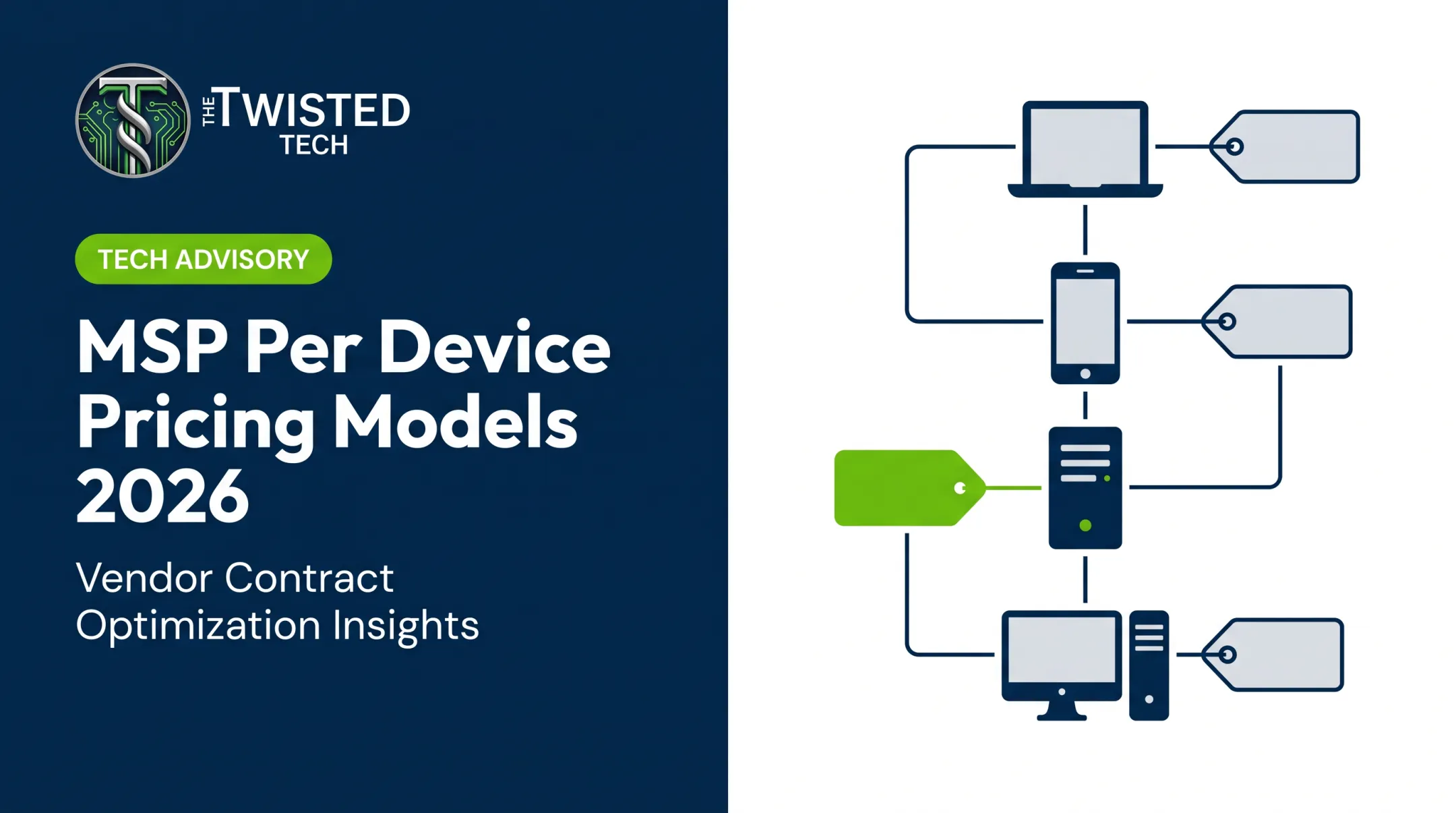
Require comparable, itemized proposals showing recurring services, security tools, licensing, onboarding, project work, onsite support, and after-hours coverage separately. MSP billing can be per device, per user, tiered, or fixed fee. A monitoring-only proposal isn't equivalent to one covering full remediation and backup.
Compare total cost of ownership and expected internal effort, not just the monthly number. Excluded services create unexpected costs later; if a proposal looks unusually low, find out what it leaves out.
Review contract terms for:
- Length, price adjustments, and renewal notice periods
- Minimum commitments and service credits
- Data ownership and documentation access
- Subcontractor terms, insurance, and breach notification
- Termination rights and transition assistance
Ask specifically what happens if you change providers later: how the provider removes credentials, returns documentation and configurations, and who handles each transfer.
Validate Claims and Make the Final Decision
Talk to current or recent clients of similar size, industry, and complexity. Ask about responsiveness, how they handled a major incident, communication quality, unexpected charges, and whether they'd renew.
Verify claims with written evidence:
- Sample reports and SLA language
- Security documentation
- Implementation milestones from past onboardings
- References with contact details, not just quotes on a website
Build a weighted scorecard that gives more weight to non-negotiable items like security, accountability, and business continuity than to nice-to-haves. Document why the winning provider was selected, what risks remain, and what conditions must be met before you sign.

How The Twisted Tech Can Help
Running this entire process alone, while still doing your day job, is a lot to ask. The Twisted Tech is an independent, vendor-neutral technology advisor that helps growing, customer-focused organizations make technology decisions around business objectives rather than provider preferences.
Our advisory work can help organizations:
- Develop requirements before approaching the market
- Research relevant provider options across the MSP landscape
- Compare proposals on equal terms
- Support contract negotiations
- Coordinate implementation and plan ongoing optimization or renewals
Because we're not tied to a single provider, clients gain access to broader market expertise, engineers, solution specialists, and implementation resources. They don't have to evaluate every option alone.
We bring the same independent approach to Microsoft licensing reviews, connectivity projects, and cybersecurity evaluations.
We're not your MSP. We help you find and vet the right one, then stay involved through implementation and beyond.
If your organization is preparing for an MSP selection, replacement, renewal, or another major technology decision, reach out to The Twisted Tech for independent guidance built around your business.
Conclusion
The best MSP isn't necessarily the biggest name, the one you've heard of most often, or the cheapest bid on the table. It's the provider that can clearly own the responsibilities you define and support the direction your organization is heading.
The process comes down to five steps:
- Define your requirements
- Compare qualified providers on equal terms
- Validate every claim
- Review the contract carefully
- Set measurable expectations before onboarding begins
MSP selection doesn't end at signing. Review performance, security posture, costs, and roadmap progress regularly, and revisit all of it before every renewal as your business needs change.
Frequently Asked Questions
What does MSP stand for in the business context?
MSP stands for Managed Service Provider. It's an external partner delivering ongoing outsourced or co-managed technology services under an agreed scope of responsibilities.
What is MSP software used for?
MSP software typically supports remote monitoring, ticketing, patch management, asset visibility, automation, and reporting. Software is only one part of an MSP's overall capability, not a substitute for skilled staff and process.
How do I choose the right managed service provider?
Start by defining your requirements and preferred service model, then evaluate security practices, relevant experience, SLA commitments, references, transparent pricing, contract terms, and scalability together, not one at a time.
What questions should I ask an MSP before signing a contract?
Ask about exact service inclusions, response and escalation procedures, cybersecurity responsibilities, the onboarding plan, documentation ownership, potential extra charges, renewal terms, and exit assistance if you leave.
What should an MSP service-level agreement include?
An SLA should cover service scope, priority levels, response and resolution targets, escalation paths, support availability, reporting, exclusions, and remedies like service credits, with response and resolution clearly distinguished.
How should I compare MSP proposals?
Use one shared requirements document, request itemized proposals, compare total cost rather than monthly price, apply a weighted scorecard, validate evidence and references, and review contract and transition terms carefully.