
Target had passed its payment-card compliance certification in September 2013. Months later, attackers breached the retailer through a vendor connection, exposing tens of millions of customer records anyway, according to reporting on Target's congressional testimony. Compliance didn't fail; it simply never promised to catch every risk.
Security compliance means meeting applicable legal, regulatory, contractual, or framework-based requirements. A risk assessment evaluates the threats, vulnerabilities, likelihood, and business impact specific to your organization. This article covers how to select the right assessment, work through the process, connect findings to your compliance obligations, and build a prioritized roadmap.
Key Takeaways
- Compliance sets a baseline; risk assessment tests whether that baseline matches your actual exposure.
- Strong assessments weigh business objectives, critical assets, sensitive data, third parties, and existing controls together.
- Findings need owners and deadlines, not a folder that resurfaces at next year's audit.
- Independent, vendor-neutral guidance helps lean IT teams prioritize and compare options before spending.
Security Compliance and Risk Assessments: How They Work Together
Compliance demonstrates alignment with a defined set of requirements. Security is the ongoing, broader effort to protect systems, data, operations, and people, whether or not a specific rule requires it.
Frameworks give structure: controls, policies, evidence requirements, accountability, and scheduled reviews. What they can't do is account for every threat unique to your organization or every new attack technique that emerges after the framework was published.
That's where risk assessment adds context. It asks what you actually own, which data and services matter most, which threats are realistic, and what happens if something breaks or gets stolen.
Three Assessment Categories You'll Encounter
Terminology varies by industry and vendor, but most assessments fall into three buckets:
- Compliance or control assessments — compare your policies and safeguards against a chosen framework, regulation, or customer contract
- Vulnerability or technical assessments — scan systems, applications, and networks for exploitable weaknesses
- Risk assessments — evaluate likelihood and impact of threats to help leadership decide what to fix first
NIST separates these functions clearly. Its risk-assessment guidance evaluates threat sources, vulnerabilities, and impact, while its control-assessment standard focuses on whether specific safeguards are implemented and working as intended. One doesn't replace the other.
Third-party exposure makes the gap real. Third parties were involved in 30% of breaches analyzed in Verizon's 2025 Data Breach Investigations Report, up from 15% the year before.
An organization can satisfy every control on its compliance checklist and still carry residual risk. Unaddressed vendor dependencies, unsupported legacy systems, and excessive access privileges are gaps a risk assessment would flag that a standard audit might miss.
What Are the Steps of a Security Risk Assessment?
A useful risk assessment follows a repeatable structure. The process typically breaks down into six steps:
Define scope and objectives. Identify which business units, locations, applications, cloud services, data types, third parties, and compliance obligations are included. Clarify what decisions the assessment needs to support.
Identify assets, processes, and information. Build or validate an inventory of critical systems, sensitive data, user populations, integrations, and owners. Incomplete inventories are a common failure point; you can't assess what you don't know exists.
Identify threats, vulnerabilities, and existing controls. Evaluate realistic threat scenarios, known technical weaknesses, process gaps, human error risks, and supply-chain dependencies. Keep the terms distinct: a vulnerability is a weakness, a threat is what could exploit it, and risk is the business consequence if it does.
Analyze likelihood and impact. Assess how plausible each scenario is and what it could mean for confidentiality, integrity, availability, legal obligations, revenue, and reputation. Use a documented scoring method rather than inventing numbers that sound precise but aren't defensible.
Prioritize and treat risks. Sort findings into categories: mitigate, transfer, avoid, accept, or monitor. Priorities should reflect business context, not just a vulnerability scanner's severity rating.
Document, assign, and review. Maintain a risk register with the finding, affected asset, rationale, owner, treatment decision, target date, dependencies, and residual risk. Set reassessment triggers after major technology changes, provider changes, regulatory updates, or new threats.

Choosing the Right Assessment and Framework
Not every organization needs every assessment type, and each answers a different question:
- Compliance gap assessments show where you stand against a specific standard
- Vulnerability assessments and penetration tests reveal where systems are technically weak
- Privacy assessments address specific data-handling obligations
- Third-party risk reviews examine vendor exposure
- Enterprise risk assessments look across the whole business
How to choose: Base your selection on:
- Industry and the types of data you handle
- Customer and contractual requirements
- Insurance expectations and operating locations
- The business outcome you're trying to achieve
Always verify current requirements from the authoritative source rather than relying on secondhand summaries, since requirements shift.
| Framework | Best fit | Key note |
|---|---|---|
| NIST CSF 2.0 | Any organization building a risk-management program | Guidance, not a certification |
| ISO/IEC 27001:2022 | Organizations wanting a formal management system | Certification is optional, not required |
| SOC 2 | Service organizations proving controls to customers | A CPA examination, not a self-assessment |
| HIPAA Security Rule | Covered entities and business associates handling ePHI | No fixed risk-analysis frequency specified |
| PCI DSS v4.0.1 | Anyone handling cardholder data | Validation requirements set by the payment brand or acquirer |
| CMMC | DoD contractors handling federal contract or controlled unclassified information | Assessment cycles vary by level; check current phase status |
State privacy laws add another layer. Colorado's Privacy Act requires data protection assessments for covered entities, and California's risk-assessment rules took effect for applicable businesses on January 1, 2026. Check these alongside your cybersecurity framework, not instead of it.
Turning Assessment Findings Into a Compliance and Security Roadmap
An assessment report that sits in a shared drive doesn't reduce risk. The findings need to become a working plan.
Build the roadmap in tiers:
- Immediate risk-reduction actions (days to weeks)
- Foundational control improvements (one to two quarters)
- Longer-term projects with dependencies and budget cycles
Each item needs an accountable owner, estimated effort, and a leadership decision point if trade-offs are involved.
Map one fix to multiple requirements. If a single remediation—say, tightening access controls—satisfies pieces of HIPAA, a customer contract, and your internal policy, document it once and reference it across all three. This cuts duplicated work without losing evidence that the control is implemented and effective.

Keep evidence in mind from the start. Auditors and customers will eventually ask for proof, not just policies. Typical requests include:
- Access review logs and remediation tracking
- Test results and training records
- Incident exercise notes and vendor documentation
Collecting this as you go beats reconstructing it under deadline pressure.
Findings often point straight to vendor and technology decisions. A gap might mean you need better contract language, tighter service-level expectations, or a different provider entirely. This is where organizations without deep internal security or procurement resources tend to get stuck. They know what's wrong, but not which providers or solutions actually solve it at a fair price.
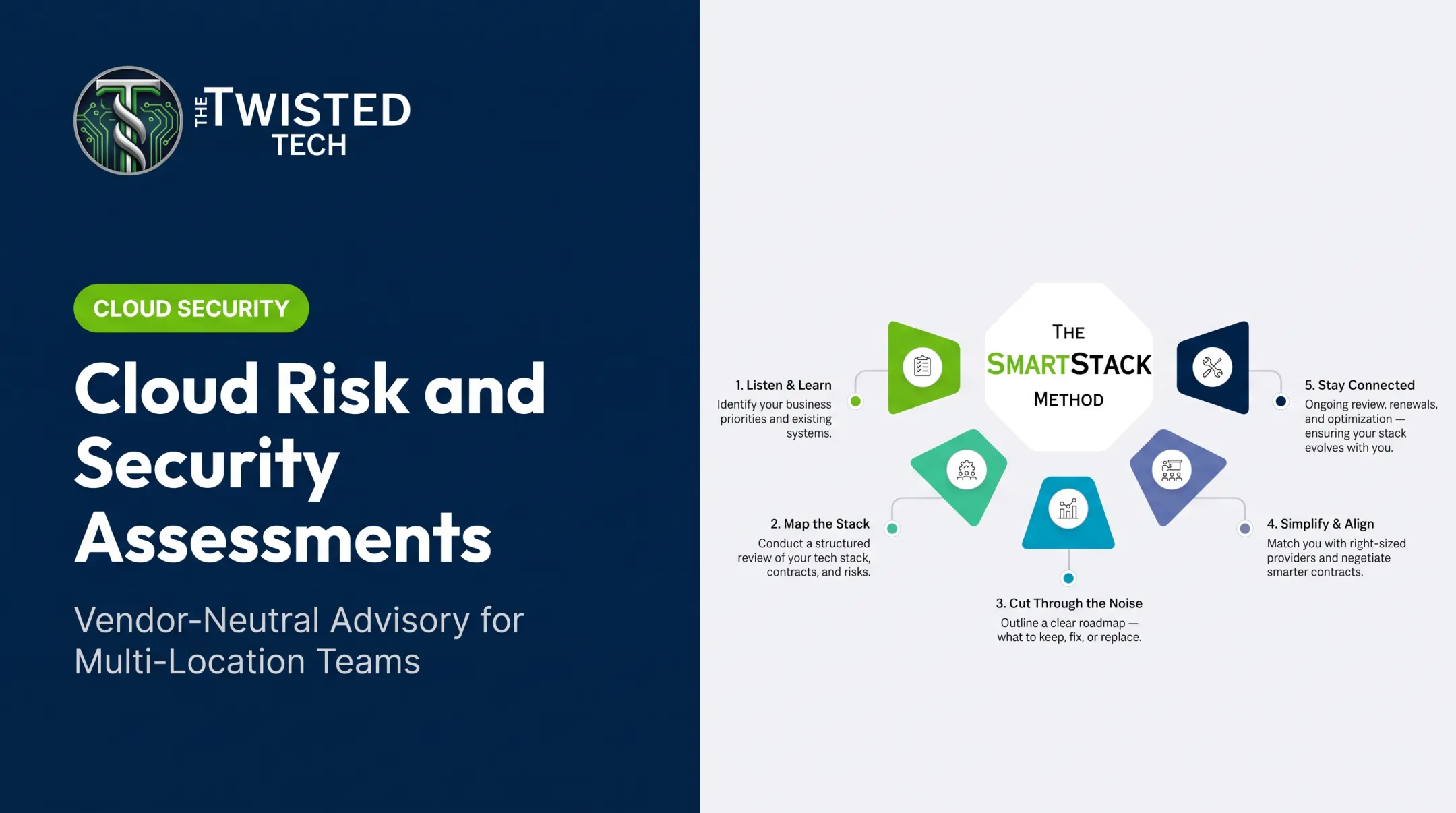
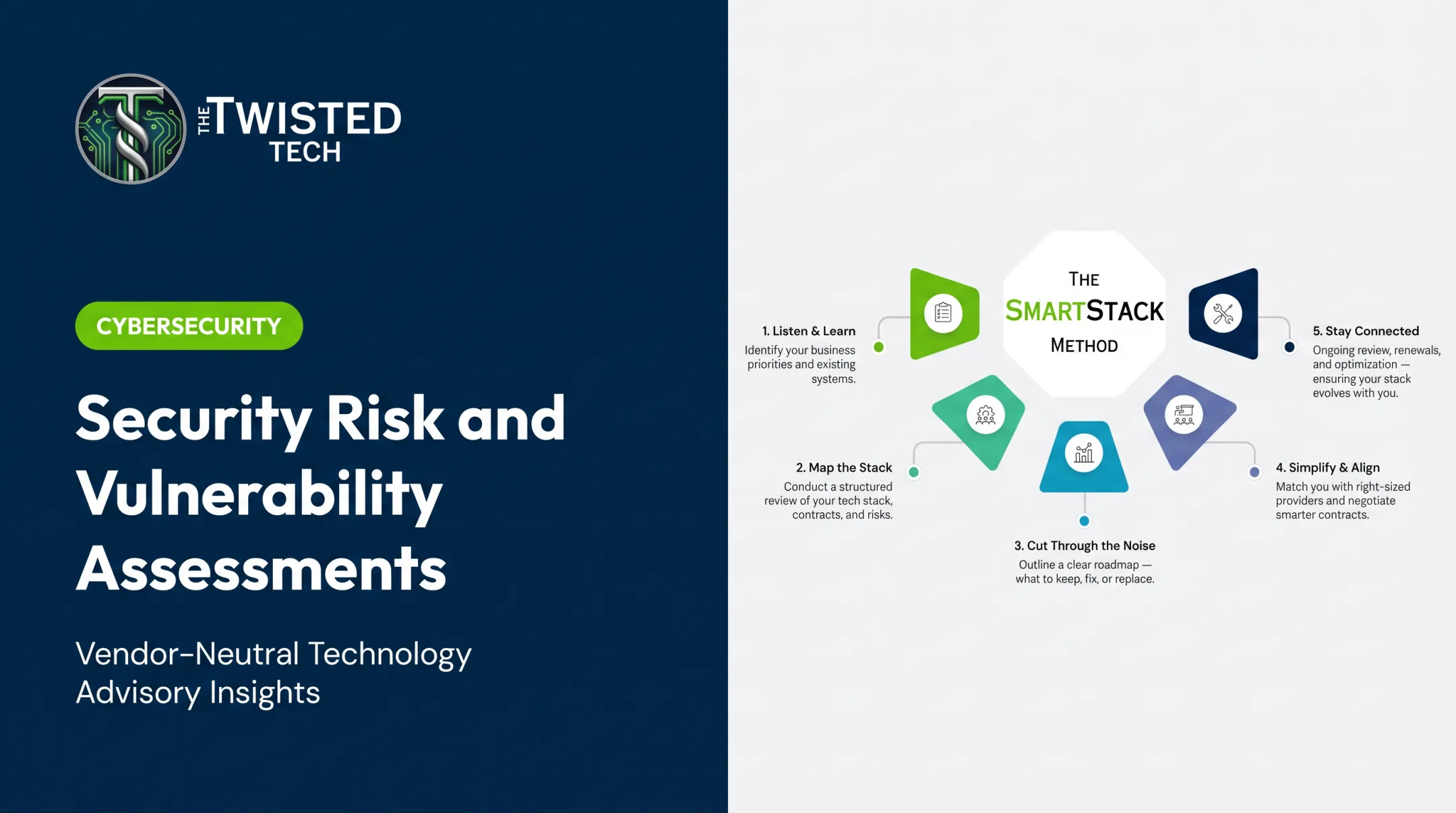
This is the exact gap The Twisted Tech's Cybersecurity Advisory work is built around. The approach starts with business objectives, the existing security environment, risk concerns, compliance requirements, and internal resource constraints before any technology or provider gets evaluated.
From there, it can extend into facilitating assessments, comparing solutions across the market, and negotiating commercial terms, all without acting as an auditor or certifying body. The goal is clarity before commitment, not a sales pitch dressed up as advice.
Maintaining Compliance After the Assessment
An assessment captures a moment in time. Systems change, vendors change, and new vulnerabilities surface constantly, so the review can't be a once-a-year event that gets forgotten in between.
Frequency depends on the framework, not a universal rule. HHS is explicit that HIPAA's Security Rule sets no fixed frequency for risk analysis. It should happen on an ongoing basis and whenever circumstances change, according to HHS guidance on risk analysis.
CMMC currently describes annual Level 1 self-assessments and three-year cycles for Levels 2 and 3. Implementation phases have shifted, so confirm your contract's current requirement directly.

Recurring activities worth building into the calendar:
- Vulnerability scans and access reviews on a fixed schedule
- Control-owner check-ins to confirm safeguards still work as designed
- Vendor monitoring, especially for critical dependencies
- Incident-response exercises at least annually
- Policy updates tied to actual operational changes
- Ongoing evidence collection instead of a pre-audit scramble
Lean IT teams face predictable obstacles:
- Manual evidence collection
- Unclear ownership
- Fragmented tools
- Overlapping framework requirements
- Remediation fatigue after the first big push
A centralized risk register, reusable control mappings across frameworks, and automation where it makes sense can absorb most of that friction without adding headcount.
Conclusion
Compliance sets the baseline. A risk assessment shows whether that baseline covers your organization's actual exposure.
Practical next steps:
- Inventory critical assets and compliance obligations
- Identify which assessment type you actually need
- Document your highest-impact risks
- Get an independent perspective before committing to tools, providers, or remediation spend
If your team lacks the bandwidth to compare options fairly, The Twisted Tech offers vendor-neutral guidance built around your business objectives, not a provider's sales quota.
Frequently Asked Questions
What are the three main types of security assessments?
Compliance or control assessments check safeguards against a defined framework or contract. Vulnerability or technical assessments scan systems for exploitable weaknesses. Risk assessments evaluate likelihood and impact to guide prioritization.
What are the steps of a security risk assessment?
Define scope and objectives, then identify assets, threats, and vulnerabilities against existing controls. Analyze likelihood and impact, prioritize and treat findings, and document results with a follow-up review schedule.
Can you give me an example of compliance testing?
A common example is reviewing user access records against a defined access-control requirement, then testing whether removed employees actually lost system access. Good testing evaluates both the policy's design and whether it operates effectively in practice.
Is a security risk assessment the same as a compliance audit?
No. A risk assessment evaluates your organization's specific exposure and treatment priorities. A compliance audit checks conformity against defined requirements. Many organizations need both.
How often should an organization perform a security risk assessment?
It depends on your risk level, contractual or regulatory requirements, and how often your business, technology, or threat environment changes. Some frameworks specify a cycle; others, like HIPAA, call for ongoing review without a fixed interval.