
Introduction
Most IT leaders have a spreadsheet somewhere listing every application the business runs. Few have a roadmap that explains what to do about them.
An application roadmap fills that gap. It's a decision-making view of where your applications stand today, what needs to change, and how those changes connect to business goals like efficiency, risk reduction, or growth.
The confusion is real. Teams often mix up application roadmaps with software development roadmaps, modernization plans, project schedules, and developer learning paths. Each serves a different purpose, and treating them as interchangeable leads to messy planning.
This guide breaks down what an application roadmap actually includes, how to build one, and how to keep it useful instead of letting it become another forgotten document.
Key Takeaways
- Build the roadmap around business outcomes and lifecycle decisions, not just technical tasks
- Assess each application to decide: retain, invest, modernize, replace, consolidate, or retire
- Use planning windows instead of fixed dates to avoid false certainty
- Treat the roadmap as a governed, regularly reviewed source of truth across departments
What Is an Application Roadmap?
An application roadmap is a high-level plan connecting an application's current state to future initiatives, milestones, and lifecycle decisions. It shows what's changing, why it matters, and roughly when it will happen.
Aging systems make the stakes concrete. Ten critical federal legacy systems reviewed by the Government Accountability Office were between 8 and 51 years old and collectively cost about $337 million annually to operate, with some running on hardware no longer supported by vendors.

That's a federal example, not a universal benchmark. Still, many organizations recognize the pattern: aging systems accumulate cost and risk until someone finally maps them out.
How It Differs From Similar Planning Documents
People use "roadmap" loosely, and that causes real confusion during planning meetings. Here's how these documents actually differ:
- Application portfolio roadmap — covers multiple applications and portfolio-wide priorities, not just one system
- Application lifecycle roadmap — tracks a single application through planning, deployment, maintenance, and retirement
- Application development roadmap — focuses on features, releases, and technical delivery for one product
- Project plan — contains detailed tasks, assignments, and delivery management once a decision is already made
- Developer learning roadmap — describes skills an individual should build, not an organizational plan at all
The Twisted Tech's Business First principle captures the point well: technology should support a business objective, not become the objective itself. A roadmap that lists modernization projects without tying them to a business reason is really just a task list wearing a nicer name.
Why Lean IT Teams Need One
Organizations with fragmented systems, upcoming renewals, or multiple locations feel this gap the most. A shared roadmap helps lean teams:
- Improve prioritization across competing system needs
- Make budget conversations clearer and easier to defend
- Manage dependencies before they become emergencies
One caveat worth repeating: a roadmap is a planning tool, not a guarantee of fixed delivery dates. It won't replace detailed implementation management, and treating it that way sets everyone up for disappointment.
What Should an Application Roadmap Include?
A useful roadmap captures consistent information across every application, not just the ones causing the most pain right now.
Core Fields to Track
For each application, record:
- Business purpose and primary users
- Owner and criticality level
- Current lifecycle stage and technology environment
- Integrations and vendor relationships
- Contract terms, renewal timing, and support status
- Cost category, risk level, and planned action
Timeline and Status Elements
Exact dates rarely hold up when discovery, procurement, or vendor readiness is still unknown. Instead, use broad planning windows:
- Now — active work or imminent decisions
- Next — queued for the coming quarter or two
- Later — identified but not yet scheduled
Pair each window with a status label so the plan stays honest about known work versus open questions:
- Active investment
- Maintenance
- Modernization
- Replacement
- Consolidation
- Retirement
Prioritization Criteria
Not every high-priority item is the cheapest one to fix. Weigh these factors together:
- Business value and user impact
- Security exposure and compliance obligations
- Technical debt and vendor risk
- Implementation effort
A $200-a-month scheduling tool can outrank a $40,000 platform renewal when it sits between booking and payments with no backup. Cost alone doesn't set urgency.
Mapping Dependencies
Dependencies determine sequencing more than almost any other factor. Map connections between applications, data sources, integrations, identity systems, and vendors before committing to a migration date.

The cost of skipping this step is well documented. A GAO review of Healthcare.gov found that integration testing between the marketplace and connected health-plan issuers hadn't been completed before launch, and required end-to-end testing never happened either.
Widespread account-creation and enrollment failures followed—problems that earlier dependency testing could have caught.
Audience-Specific Views
Not every stakeholder needs the same level of detail. Build views tailored to:
- Executives — strategic outcomes, investment windows, and major decisions
- IT and architecture — dependencies, technical health, and target state
- Business owners — user impact, process changes, and expected benefits
- Finance and procurement — budget timing, licensing, and contract terms
How to Create an Application Roadmap: A Step-by-Step Process
Building a roadmap isn't a one-afternoon exercise. It follows a sequence, and skipping steps usually means redoing work later.
Define scope and purpose first. Establish which questions the roadmap must answer: which systems need investment, which renewals require review, and what's creating risk. Identify sponsors from IT, finance, security, and affected business teams before collecting a single data point.
Build and validate an application inventory. Capture everything, including spreadsheets, departmental tools, shadow IT, and systems managed by outside providers. Don't copy a list straight from a single vendor's dashboard; validate it with the people who actually use and support each system.
Assess current state using consistent criteria. Review each application's business fit, security posture, supportability, technical debt, and total cost. Gartner's TIME framework (Tolerate, Invest, Migrate, Eliminate) structures these assessments around business fitness, technology fitness, risk, and cost—not a single metric.
Choose a strategic disposition for each application. Options include retain, invest, modernize, replace, consolidate, rehost, refactor, rebuild, or retire. Modernizing isn't automatically the right answer. Sometimes retiring or consolidating serves the business better, even when a system still technically works.
Prioritize and sequence realistically. Combine business value, urgency, dependency order, and resource capacity. Separate quick wins from foundational work so stakeholders understand why some initiatives land earlier than others. Contract renewals and end-of-support notices create real deadlines; avoid inventing dates that haven't been validated.
Turn decisions into initiatives with owners and gates. Define what must happen during discovery, procurement, implementation, and stabilization. Specify what evidence (signed contracts, tested integrations, completed training) moves an initiative from one stage to the next. The roadmap should connect to a detailed project plan, not double as one.

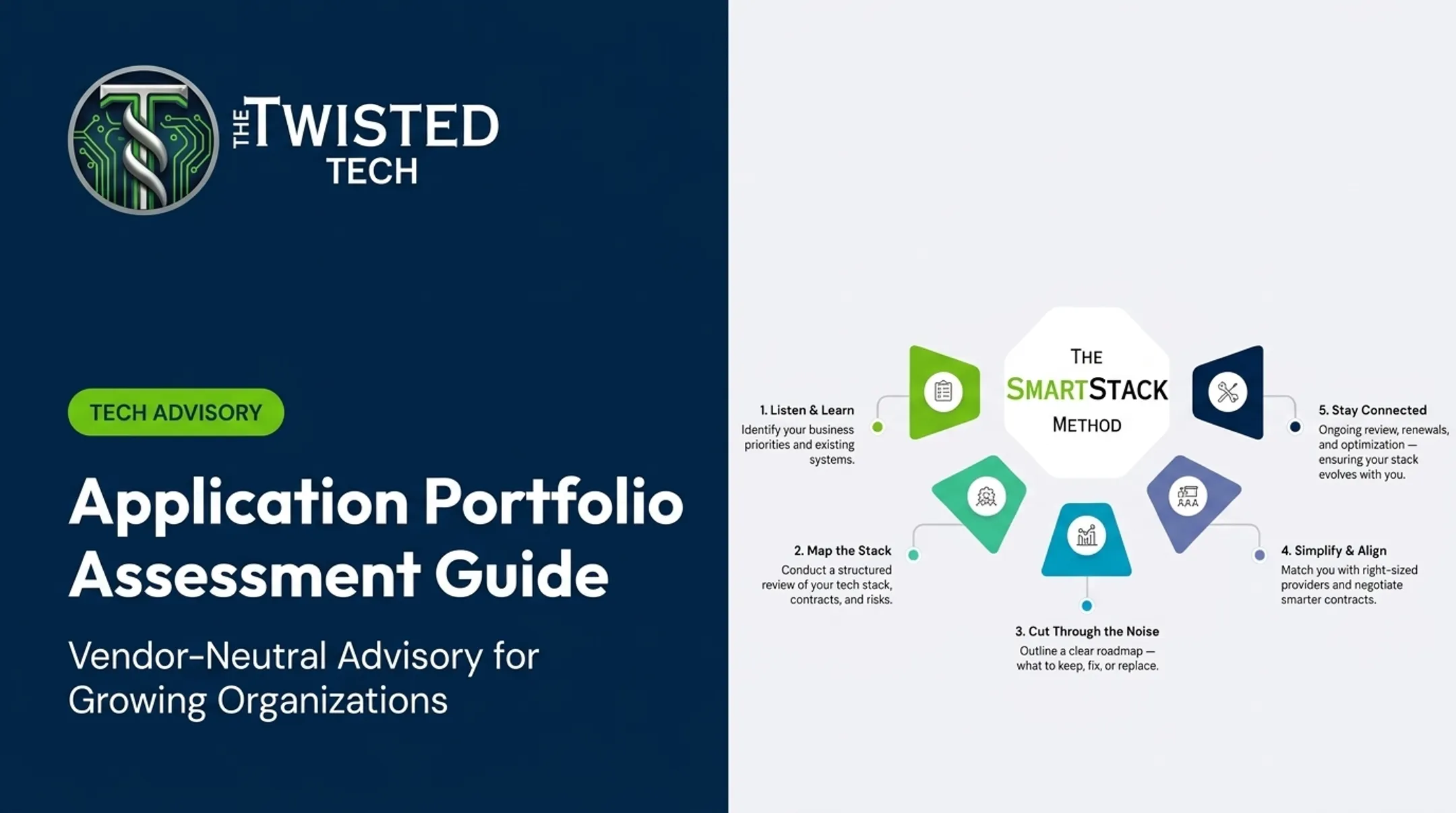
The Twisted Tech's SmartStack approach follows similar logic, starting with a "Listen & Learn" stage to clarify organizational goals before mapping the technology stack. In one case, a private education organization facing its longtime IT leader's retirement built a roadmap first—then evaluated managed IT partners—instead of jumping straight to vendor comparisons.
How to Use and Maintain the Roadmap
A roadmap that never gets updated becomes a historical document instead of a decision tool. Governance is what keeps it alive.
Assign Ownership and a Review Cadence
Name an accountable roadmap owner. Require application owners to validate their information at set intervals or when major changes occur (a new contract, a security incident, or a vendor acquisition).
Tie updates to natural checkpoints like procurement events, architecture reviews, and renewal cycles instead of an arbitrary calendar date.
Review With the Right Audience
Different decisions need different rooms:
- Leadership reviews handle investment, risk, and sequencing
- Technical reviews cover dependencies, integrations, and data migration
- Business reviews address process impact, training, and adoption
- Finance and procurement reviews focus on contracts and licensing
Keep a Feedback Loop Running
Document assumptions, deferred work, and changes to planned timing so the roadmap stays trusted rather than becoming a source of surprises. After implementation, track outcomes like adoption rates, service quality, and cost alignment against what was expected.
The Twisted Tech's "Prepare for a Major Renewal" guidance asks one question before recommitting to any platform: would we make the same decision today? That question alone often reshapes a roadmap's next quarter.
In one engagement, a growing financial services organization asked exactly that about its communications platform, and the answer was to renew and improve what it had rather than replace it. Sometimes keeping the current system is the right call. A good roadmap process should reach that conclusion as easily as it reaches "replace."
For organizations without the internal bandwidth to run this process alone, The Twisted Tech works as an independent resource for developing requirements, evaluating provider options, comparing proposals, and coordinating implementation. The work stays vendor-neutral rather than tied to one provider's agenda.
Common Application Roadmap Challenges and Best Practices
Most roadmap failures trace back to three recurring problems.
- Incomplete or conflicting inventory data. Assign clear ownership for each application record and validate details with business and technical teams. Where confidence is low, say so. A documented assumption beats a confident guess.
- Siloed decision-making. Involve users, IT, security, finance, and procurement before finalizing priorities. A roadmap built only by IT usually misses the business context that makes prioritization defensible.
- Too much detail, or not enough. Keep the main roadmap readable. Push technical depth into linked docs and build audience-specific views instead of forcing executives to parse integration diagrams.
Avoid these three traps specifically:
- Turning the roadmap into a static slide deck nobody revisits
- Letting it become an unprioritized wish list
- Committing to exact dates before dependencies, procurement, and testing are understood
For technology decisions, a few practices hold up:
- Connect every major initiative to a business objective or risk, not just a technical preference
- Evaluate multiple providers rather than accepting a single vendor's recommended path
- Include security, data ownership, support terms, and exit requirements in every evaluation
- Plan for adoption and renewal decisions, not just the initial purchase
The Twisted Tech's "Complexity Should Earn Its Place" principle applies directly: more tools and vendors don't automatically create better outcomes. Sometimes the best roadmap decision is subtraction.
Frequently Asked Questions
What is the roadmap for app development?
An app development roadmap outlines product vision, features, releases, and technical priorities for building or improving a single application. It's different from a portfolio or lifecycle roadmap, which decides whether that application should exist at all.
What exactly is a roadmap?
A roadmap is a high-level plan communicating direction, priorities, timing, and dependencies without replacing a detailed project schedule. It answers "what and why." The project plan answers "who does what by when."
What is an example of a roadmap?
Five applications might move through assessment, provider evaluation, modernization, implementation, and retirement. Each step ties to a business reason, such as a contract renewal or security gap, with a rough planning window rather than a fixed date.