
Introduction
Technology spend rarely grows in a straight line. It spreads.
A new department picks its own project tool. A regional office signs its own internet contract. A manager adds a premium security tier nobody asked for.
Within a few years, growing organizations are juggling software, cloud services, connectivity, business communications, cybersecurity tools, managed services, and a stack of separate provider contracts that nobody fully owns.
Spend optimization means understanding where the money actually goes, whether that spending creates real business value, and where it should move instead. Blind cuts across every line item are not a strategy.
Only 43% of IT professionals surveyed report having complete visibility into their organization's IT assets, and that number is trending down, not up, according to Flexera's 2025 State of ITAM Report. If your team can't see the full picture, optimizing it is guesswork.
This article walks through a practical approach: build visibility, assess value and risk, act on what you find, then keep the process running.
Key Takeaways
- Tie technology spend to business outcomes, risk tolerance, and future priorities—not just this quarter's budget
- Start with a full inventory of vendors, contracts, usage, and renewal dates
- Rightsizing licenses and cutting duplication win fast; lasting results need ongoing governance
- Vendor-neutral guidance helps lean teams compare real alternatives, not one provider's pitch
What Is Spend Optimization and How Does It Differ From Cost Cutting?
Cost cutting asks one question: how do we spend less? Spend optimization asks a better one: are we spending the right amount, on the right things, to get the results we need?
According to Gartner, strategic IT cost optimization is continuous, outcome-driven work that reduces waste and redirects resources toward business priorities. It differs from reactive, short-term cuts made under budget pressure.
A blanket 15% cut can just as easily gut a critical security tool as it can eliminate a genuinely wasted subscription.
Real optimization balances savings against:
- Employee productivity and workflow continuity
- System resilience and uptime
- Customer experience quality
- Cybersecurity posture and compliance obligations
- Scalability as the organization grows
- Room for future innovation
Spend management and spend optimization aren't the same thing. Management is the visibility and control layer, knowing what you have, what it costs, and when it renews. Optimization is what you do with that information: decisions that improve outcomes, not just spreadsheets that look tidy.
Where Technology Spend Typically Hides
Most organizations need to review spend across several categories simultaneously:
- Software and licensing (including Microsoft 365 and other SaaS platforms)
- Cloud and infrastructure services
- Business communications and collaboration tools
- Connectivity and network services
- Cybersecurity tools and monitoring
- Managed IT and support services
- Hardware and professional services contracts
Common Sources of Inefficient Spend
Some waste is obvious once you look. Unused seats, duplicate applications doing the same job, premium features nobody adopted, and forgotten subscriptions still charging a corporate card.
These add up fast, especially across departments that purchased independently.
Other leakage is harder to spot:
- Shadow IT purchased outside procurement oversight
- Decentralized buying across departments with no shared visibility
- Auto-renewals that lock in outdated pricing or terms
- Unfavorable minimum commitments signed years earlier
- Contracts with unclear internal ownership
Here's the part teams miss most often: the cheapest option isn't always the best one. Switching costs, implementation effort, security exposure, downtime risk, weak support, and low adoption can all erase a lower sticker price within months.
Why Visibility Is the Foundation
You cannot optimize spend that you cannot identify. That sounds obvious, but it's where most efforts stall before they start.
Only 43% of IT professionals report having complete visibility into their IT assets and how those assets affect business outcomes, down from 47% the year before. Just half report accurate visibility into SaaS specifically (Flexera). Visibility is getting harder, not easier, as environments grow more distributed.
That gap shows up in waste. 35% of survey respondents said wasted SaaS spending increased over the prior year. Advanced asset-management practitioners self-estimated waste rates around 20% for SaaS, 30% for desktop software, and 21% for IaaS/PaaS (Flexera). Those are estimates from experienced teams, not guaranteed benchmarks, but they signal how much slips through unnoticed.

A useful inventory needs to capture:
- Vendors and products in use
- Contract terms and renewal dates
- Users, locations, and dependencies
- Business owners and business purpose
- Actual costs versus budgeted costs
Without this baseline, every optimization decision is a guess dressed up as a strategy.
A Practical Spend Management Framework
Treat spend optimization as an ongoing framework, not a one-time audit. Four stages work well: discover, assess, act, and monitor, each tied to a specific decision rather than a checkbox.
Getting there requires more than one department:
- Finance tracks the dollars
- IT knows the systems
- Procurement manages the contracts
- Business-unit leaders understand the actual use case
- Security flags the risk
- Executive sponsors keep priorities aligned
Skip any one of these, and the picture stays incomplete.
Once data is gathered, segment it by:
- Category and provider
- Business owner and criticality
- Contractual commitment and strategic importance
Then prioritize with a mix of:
- Financial impact and risk
- User impact and urgency
- Complexity and time to value
A quick example: two services cost roughly the same each month. One runs a business-critical function and sits locked into a two-year contract. The other duplicates a capability the team already has elsewhere and renews in 60 days. Same price tag, very different priority.
Stage One: Discover and Normalize the Data
Pull records from:
- Invoices and general-ledger entries
- Procurement systems and expense reports
- Corporate card statements
- Identity systems and admin consoles
- Contracts and provider portals
Skipping any source creates blind spots later.
Standardize everything before analyzing it. Vendor names, product names, billing periods, departments, and categories need consistent labels, or the same tool will show up three different ways in your reporting. Handle incomplete records and disputed invoices as they surface, and flag services bundled inside larger provider agreements separately so they don't get lost.
Stage Two: Assess Value, Usage, Risk, and Fit
Compare what you're paying for against what's actually being used. For each service, ask:
- Does it support a current business requirement?
- Does it have an accountable owner?
- Does it meet security and compliance needs?
- Does it integrate well with the rest of the environment?
Low usage doesn't automatically mean cancel. A seasonal tool, a resilience safeguard, or a system that's expensive to replace might justify its cost even with light day-to-day use. Assess criticality and replacement cost before pulling the plug.
Stage Three: Act on Prioritized Opportunities
Sort actions into four buckets: quick wins, renewal actions, strategic changes, and longer-term transformation. Confusing an immediate discount with a durable fix is a common trap.
Typical actions include:
- Reclaiming unused licenses and downgrading oversized plans
- Consolidating duplicate tools serving the same function
- Correcting billing errors found during discovery
- Adjusting consumption settings on cloud or usage-based services
- Renegotiating terms ahead of renewal
- Improving adoption of tools already paid for
Before approving any change, document the expected financial, operational, security, and user impact. This is the internal record that keeps decisions defensible later.
The FinOps Foundation's current framework mirrors this cycle almost exactly: understand usage and cost, quantify business value, optimize usage and cost, then manage the practice on an ongoing basis (FinOps Foundation). It's built for cloud spend originally, but the logic applies just as well to SaaS, connectivity, and communications.
Stage Four: Monitor and Keep the Cycle Alive
Track realized savings and service levels against the impact you documented in Stage Three. Watch usage drift, ownership changes, and upcoming renewals so priorities stay current.
Feed what you learn back into discovery. The framework holds only when monitor findings restart the next pass instead of sitting in a one-time report.

Practical Spend Optimization Playbook
Turning a framework into results means running specific plays, not just talking about strategy.
- Build the inventory first. Record what the organization owns, uses, pays for, and depends on—including shadow IT and off-procurement purchases.
- Rightsize before you rationalize. Use utilization and entitlement data to adjust licenses, tiers, cloud resources, and support levels without creating gaps.
- Rationalize overlapping tools. Compare capabilities, adoption, support, security, contracts, and total cost of ownership before choosing which tool stays.
- Get ahead of renewals. Review usage, performance, alternatives, and leverage well before notice periods or auto-renewal deadlines.
- Tighten contract and vendor management. Track renewal dates, escalators, commitments, SLAs, termination rights, and data portability in one place.
- Reinvest what you save. Put validated savings toward resilience, cybersecurity, customer experience, or infrastructure that supports growth.
How to Conduct a Useful Spend Analysis
A good spend analysis answers practical questions: who's spending, with which provider, on what service, for what business purpose, at what price, under what terms, and with what result.
Fictional example: Acme Nonprofit discovers it pays for two separate video conferencing platforms across departments, each costing roughly $400 a month. One department adopted it fully; the other barely uses it and inherited the tool during a merger three years ago.
The underused platform's contract renews in 45 days with no penalty for cancellation. That's a straightforward consolidation opportunity, but only after confirming the low-usage team has a clear migration path and no integration dependency on the platform being cut.

Total Cost of Ownership and Business Value
Subscription price is only one line in the real cost. Gartner's total cost of ownership guidance factors in implementation, integration, administration, training, support, migration, downtime, renewal, and exit costs. A cloud migration that looks cheaper on paper can still produce a higher total cost once these factors surface.
Connect each decision to outcomes that matter:
- Productivity and customer experience
- Service availability and risk reduction
- Compliance readiness or revenue enablement
A consistent scoring model helps stakeholders compare unlike investments (a security tool against a collaboration platform, for example) without reducing every decision to price alone.
Governance and Measurement for Ongoing Spend Management
Optimization done once fades within a year. Governance is what keeps it from sliding backward.
Start with clear ownership. Every major category and contract needs a named person who approves purchases, monitors usage, manages renewals, and answers for business outcomes. Without that, spend drifts back into the same fragmentation that started the problem.
Set a review cadence for usage, invoices, contracts, provider performance, new requests, and upcoming renewals. High-spend or high-risk categories deserve monthly attention; lower-stakes tools can wait for a quarterly check-in.
Useful KPIs to track and tailor include:
- Visibility coverage across the technology environment
- Unused-license rate
- Realized renewal savings
- Contract compliance
- Duplicate-tool reduction
- Adoption rates on paid tools
Those metrics only hold if intake stays controlled. Procurement policies, approval workflows, and preferred-provider lists prevent new waste from creeping back in, as long as they don't slow down legitimate business needs.
None of this works in a silo. IT, finance, procurement, security, and business leaders need a shared view. Without it, independent decisions recreate the same fragmentation this process is meant to fix.
When Independent Technology Guidance Can Improve Spend Decisions
Some organizations run this entire process internally, and that's the right call when they have the bandwidth and expertise. Others don't, and that's usually where outside guidance earns its place.
Signs it might be time to bring in independent support:
- Limited internal IT capacity to run a full spend review
- A fragmented environment built up over years of decentralized buying
- A major renewal approaching with no clear negotiating position
- Uncertainty about which providers or pricing models actually fit
- Legacy services nearing retirement with no replacement plan yet
A vendor-neutral advisor translates business requirements into evaluation criteria, researches the market, and helps stakeholders weigh real trade-offs instead of relying on a single provider's pitch.
The Twisted Tech was built around that gap. Founder Ryan Hanson saw that many organizations lack the bandwidth or market visibility to evaluate every option on their own, and providers rarely share much about their competitors.
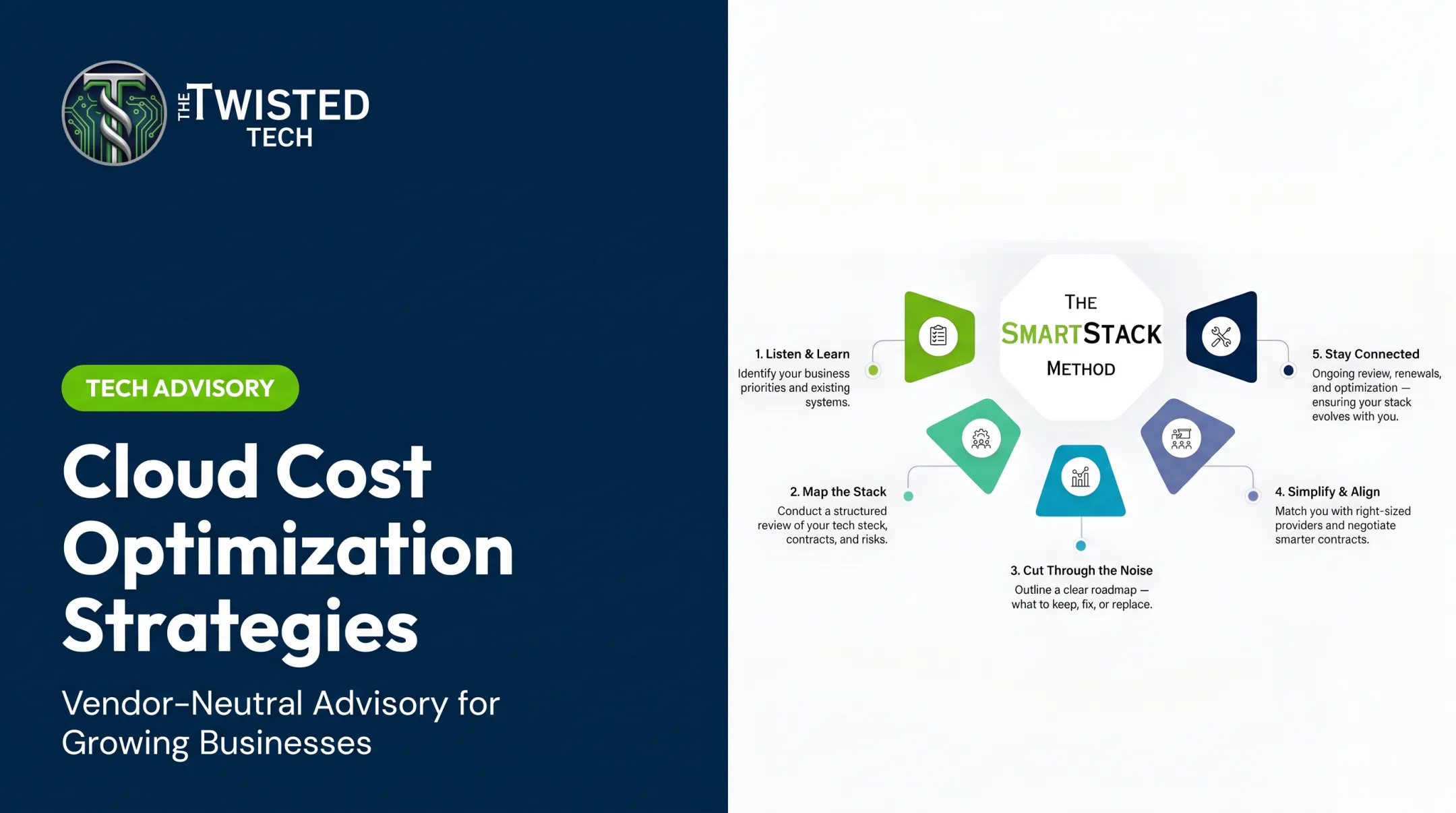
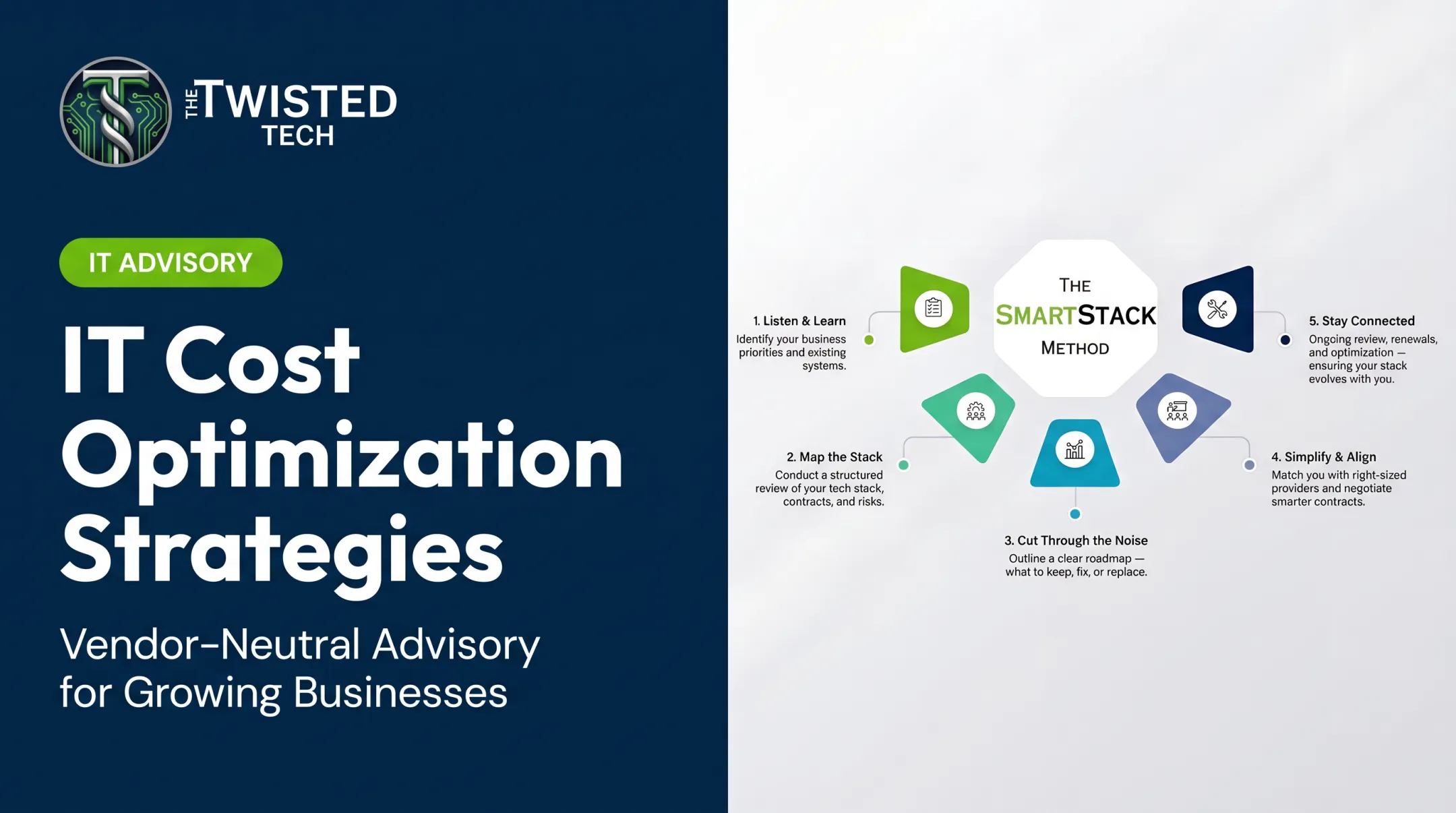
The firm's SmartStack Method maps existing technology, contracts, and internal resources before comparing alternatives, then supports negotiation, implementation, and renewals after a decision is made.
One example: a review for a multi-location organization with more than 250 remote sales employees uncovered roughly $8,000 per month in unnecessary Microsoft licensing costs, an amount identified during the review, not a realized saving.
An advisor’s job is to support decision-making. Recommendations stay tied to business objectives and total cost of ownership, and internal teams keep ownership of the final call.

Frequently Asked Questions
What is cost optimization in simple terms?
Cost optimization means getting the business result you need at the right level of spending. The goal is cutting waste while protecting quality, security, and long-term priorities.
What does spend mean in procurement?
Spend is the money an organization commits or pays to suppliers for goods, services, and technology. It covers direct purchases and less visible costs such as auto-renewed subscriptions or informal buys.
What's an example of spend analysis?
Reviewing invoices and usage data might show two departments paying for the same video conferencing tool, with one barely used and a contract renewing in 45 days. That finding creates a clear, low-risk consolidation opportunity.